Sulcavis
Sulcavis is a genus of enantiornithean birds. One species is named, Sulcavis geeorum. The fossil was found in Early Cretaceous (121-125 million years ago) rocks in Liaoning Province, China.
| Sulcavis Temporal range: Early Cretaceous, , | |
|---|---|
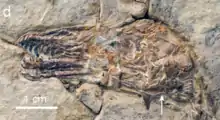 | |
| Fossil skull | |
Scientific classification  | |
| Kingdom: | Animalia |
| Phylum: | Chordata |
| Clade: | Dinosauria |
| Clade: | Saurischia |
| Clade: | Theropoda |
| Clade: | Avialae |
| Clade: | †Enantiornithes |
| Family: | †Bohaiornithidae |
| Genus: | †Sulcavis O’Connor et al., 2013 |
| Type species | |
| †Sulcavis geeorum O’Connor et al., 2013 | |
Sulcavis is the first discovery of a bird with ornamented tooth enamel. The enantiornitheans are unique among birds in showing minimal tooth reduction and a diversity of dental patterns. Sulcavis had robust teeth with grooves on the inside surface, which likely strengthened the teeth against harder food items. No previous bird species have preserved ridges, striations, serrated edges, or any other form of dental ornamentation.[1]
Discovery
The holotype of Sulcavis, BMNH Ph-000805, is discovered near the town of Lamadong, in Liaoning Province, China. The fossil was found in the Yixian Formation, an Early Cretaceous rock formation. . The genus was described on January 9, 2013, in an article that was published in the Journal of Vertebrate Paleontology by Jingmai Kathleen O'Connor, Yuguang Zhang, Luis Maria Chiappe, Qingjin Meng, Li Quanguo and Liu Di.
The type species of the new genus was named Sulcavis geeorum by the team of scientists. The genus name comes from the Latin words "sulcus" (groove) and "avis" (bird), reflecting the unusual dental characteristics of the genus. The species name is to honour the Gee family from La Cañada (US) "because of their generous contributions to the research of Mesozoic birds".[1] The holotype of Sulcavis geeorum was prepared by Maureen Walsh at the Natural History Museum of Los Angeles County, USA.
Phylogeny
The cladogram below follows O’Connor et al., 2013 phylogenetic analysis.[1]
| Pygostylia |
| |||||||||||||||||||||||||||||||||||||||||||||||||||||||||||||||||||||||||||||||||||||||||||||||||||||||||||||||||||||||||||||||||
References
- O’Connor, J. K.; Zhang, Y.; Chiappe, L. M.; Meng, Q.; Quanguo, L.; Di, L. (2013). "A new enantiornithine from the Yixian Formation with the first recognized avian enamel specialization". Journal of Vertebrate Paleontology. 33: 1. doi:10.1080/02724634.2012.719176.
.png.webp)
.jpg.webp)