Pengornithidae
Pengornithidae is a group of early enantiornithines from the early Cretaceous Period of China, with the putative member Falcatakely possibly extending this clade's range into the Late Cretaceous of Madagascar,[2] and several putative pengornithids also hail from this formation.[3] Specimens of these animals have been found both in the Huajiying Formation and Jiufotang Formation of Liaoning and Hebei provinces, dating from the Hauterivian age (130.7 million years ago) to the Aptian age (120 million years ago).[4]
| Pengornithids Temporal range: Early Cretaceous, (possible Late Cretaceous reccord) | |
|---|---|
 | |
| Fossil specimen of Parapengornis eurycaudatus | |
Scientific classification  | |
| Kingdom: | Animalia |
| Phylum: | Chordata |
| Clade: | Dinosauria |
| Clade: | Saurischia |
| Clade: | Theropoda |
| Clade: | Avialae |
| Clade: | †Enantiornithes |
| Family: | †Pengornithidae Wang et al., 2014 |
| Type genus | |
| †Pengornis Zhou, Clarke, & Zhang, 2008 | |
| Genera | |
| |
Description
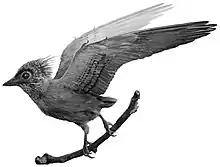
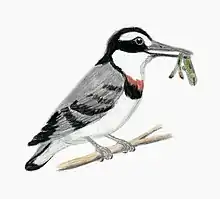
Pengornithids were basal enantiornithes. They had many small teeth in their jaws, and stout legs. Their internal anatomy was characterized by a hooked outgrowth of the shoulder blade and a pygostyle (the tail bone to which long feathers attach) which was short and rounded, instead of long and blade-shaped as in other enantiornithes. While most enantiornithes had four long backward projections growing from their breastbones, pengornithids only had two.[5]
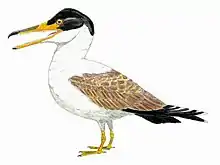
Assuming Falcatakely is a pengornithid, it exhibits a rather novel cranial morphology compared to other enantiornitheans, having a toucan-like snout ending on small teeth.
Ecology
The unique, rounded pygostyle and long, stiff tail feathers of pengornithids would have made their tail overall similar to that of woodpeckers. The feet of pengornithids were also particularly adapted for grasping branches. These features indicate that while pengornithids may not have been as adept at climbing as many modern birds, they were better climbers than many other enantiornithes.[5]
Falcatakely has been compared to toucans due to similar snout morphology.
Classification
The cladogram below was found in the phylogenetic analysis of Hu et al. 2014.[5]
| Enantiornithes |
| ||||||||||||||||||||||||||||||||||||||||||||||||||||||||||||||||||||||||||||||||||||||||||||||||||||||||||||||||||||||||||||||
The cladogram below was found by an analysis by Wang et al. in 2015, updated from a previous data set created by Jingmai O'Connor.[6]
| Ornithothoraces |
| ||||||||||||||||||||||||||||||||||||||||||||||||||||||||||||||||||||||||||||||||||||
References
- O'Connor, P. M.; Turner, A. H.; Groenke, J. R.; et al. (2020). "Late Cretaceous bird from Madagascar reveals unique development of beaks". Nature. doi:10.1038/s41586-020-2945-x
- O'Connor, P. M.; Turner, A. H.; Groenke, J. R.; et al. (2020). "Late Cretaceous bird from Madagascar reveals unique development of beaks". Nature. doi:10.1038/s41586-020-2945-x
- O'Connor and Forster, 2010. A Late Cretaceous (Maastrichtian) avifauna from the Maevarano Formation, Madagascar. Journal of Vertebrate Paleontology. 30(4), 1178-1201.
- Wang, X.; O'Connor, J. K.; Zheng, X.; Wang, M.; Hu, H.; Zhou, Z. (2014). "Insights into the evolution of rachis dominated tail feathers from a new basal enantiornithine (Aves: Ornithothoraces)". Biological Journal of the Linnean Society. 113 (3): 805–819. doi:10.1111/bij.12313.
- Hu, Han; o'Connor, Jingmai K.; Zhou, Zhonghe (2015). "A New Species of Pengornithidae (Aves: Enantiornithes) from the Lower Cretaceous of China Suggests a Specialized Scansorial Habitat Previously Unknown in Early Birds". PLOS ONE. 10 (6): e0126791. doi:10.1371/journal.pone.0126791. PMC 4454694. PMID 26039693.
- Wang, Hu; Li (2015). "A new small enantiornithine bird from the Jehol Biota, with implications for early evolution of avian skull morphology". Journal of Systematic Palaeontology. 14 (6): 1–17. doi:10.1080/14772019.2015.1073801. S2CID 83603202.
.png.webp)
.jpg.webp)