Stangerochampsa
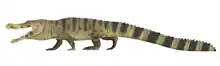
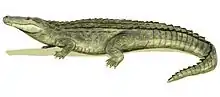
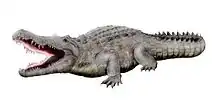
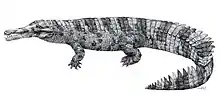
Stangerochampsa is an extinct genus of globidontan alligatoroid, possibly an alligatorine or a stem-caiman, from the Late Cretaceous of Alberta. It is based on RTMP.86.61.1, a skull, partial lower jaws, and partial postcranial skeleton discovered in the late Campanian–early Maastrichtian-age Horseshoe Canyon Formation. Stangerochampsa was described in 1996 by Wu and colleagues. The type species is S. mccabei. The generic name honors the Stanger family, the owners of the ranch where the specimen was found, and the species name honors James Ross McCabe, who discovered, collected, and prepared it. Stangerochampsa is described as "small to medium–sized"; the type skull is 20.03 centimetres (7.89 in) long from the tip of the snout to the occipital condyle, and is 13.0 centimetres (5.1 in) wide at its greatest, while the thigh bone is 14.2 centimetres (5.6 in) long. It had heterodont dentition, with large crushing teeth at the rear of the jaws.[2]
| Stangerochampsa Temporal range: Late Cretaceous, | |
|---|---|
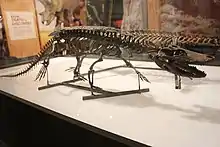 | |
| Skeletal mount on display at the National Museum of Natural History | |
Scientific classification  | |
| Kingdom: | Animalia |
| Phylum: | Chordata |
| Class: | Reptilia |
| Order: | Crocodilia |
| Superfamily: | Alligatoroidea |
| Clade: | Globidonta |
| Genus: | †Stangerochampsa Wu et al., 1996 |
| Type species | |
| †Stangerochampsa mccabei Wu et al., 1996 | |
Classification
Wu and colleagues, using phylogenetic analyses, found their new genus to be closest to Brachychampsa, and then Albertochampsa and Hylaeochampsa successively, as part of a clade within Alligatorinae that also included Allognathosuchus, Ceratosuchus, and Wannaganosuchus. This arrangement also unites most Mesozoic and Paleogene alligatorines.[2] Brochu (1999), in an analysis of all alligatoroids, found Stangerochampsa and Brachychampsa to be just outside Alligatoridae, and suggested that Stangerochampsa and Albertochampsa were synonymous.[3] Brochu (2004)[4] and Hill and Lucas (2006)[5] also found Stangerochampsa to be outside of Alligatorinae; Hill and Lucas found Albertochampsa to its sister taxon.[5]
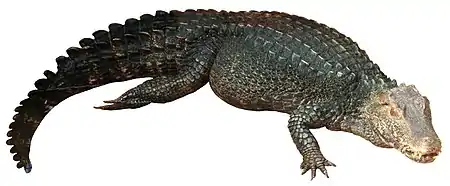
Below is a cladogram based on the results of a 2018 tip dating study by Lee & Yates that simultaneously used morphological, molecular (DNA sequencing), and stratigraphic (fossil age) data, which shows Stangerochampsa's placement within Globidonta.[6]
| Crocodylia |
| ||||||||||||||||||||||||||||||||||||||||||||||||||||||||||||||||||||||||||||||||||||




_white_background.jpg.webp)

On the other hand, in the phylogenetic analysis conducted by Bona et al. (2018) Stangerochampsa was recovered as an alligatorid, specifically as a stem-caiman, as shown in the cladogram below.[7]
| Alligatoroidea |
| |||||||||||||||||||||||||||||||||||||||||||||||||||||||||||||||||||||||||||||||||||||||||||||||||||||||||||||||||||||||||||||||||||||||||||||||||||||||||||||||||||||||||||||||||||||||||||||||||||||||||||||||
| (stem-based group) |
References
- Rio, Jonathan P.; Mannion, Philip D. (6 September 2021). "Phylogenetic analysis of a new morphological dataset elucidates the evolutionary history of Crocodylia and resolves the long-standing gharial problem". PeerJ. 9: e12094. doi:10.7717/peerj.12094. PMC 8428266. PMID 34567843.
- Wu, Xiao-Chun; Brinkman, Donald B.; Russell, Anthony P. (1996). "A new alligator from the Upper Cretaceous of Canada and the relationships of early eusuchians" (PDF). 39 (2): 351–375. Archived from the original (PDF) on 2011-09-28.
{{cite journal}}: Cite journal requires|journal=(help) - Brochu, C. A. (1999). "Phylogenetics, taxonomy, and historical biogeography of Alligatoroidea". Society of Vertebrate Paleontology Memoir. 6: 9–100. doi:10.2307/3889340. JSTOR 3889340.
- Brochu, Christopher A. (2004). "Alligatorine phylogeny and the status of Allognathosuchus Mook, 1921". Journal of Vertebrate Paleontology. 24 (4): 857–873. doi:10.1671/0272-4634(2004)024[0857:APATSO]2.0.CO;2. JSTOR 4524781.
- Hill, Robert V.; Lucas, Spencer G. (2006). "New data on the anatomy and relationships of the Paleocene crocodylian Akanthosuchus langstoni" (PDF). Acta Palaeontologica Polonica. 51 (3): 455–464.
- Michael S. Y. Lee; Adam M. Yates (27 June 2018). "Tip-dating and homoplasy: reconciling the shallow molecular divergences of modern gharials with their long fossil". Proceedings of the Royal Society B. 285 (1881). doi:10.1098/rspb.2018.1071. PMC 6030529. PMID 30051855.
- Paula Bona; Martín D. Ezcurra; Francisco Barrios; María V. Fernandez Blanco (2018). "A new Palaeocene crocodylian from southern Argentina sheds light on the early history of caimanines". Proceedings of the Royal Society B: Biological Sciences. 285 (1885): 20180843. doi:10.1098/rspb.2018.0843. PMC 6125902. PMID 30135152.
Extinct crocodilians | |||||||||||||||||||||||||||||||||||||||||
|---|---|---|---|---|---|---|---|---|---|---|---|---|---|---|---|---|---|---|---|---|---|---|---|---|---|---|---|---|---|---|---|---|---|---|---|---|---|---|---|---|---|
| |||||||||||||||||||||||||||||||||||||||||
| |||||||||||||||||||||||||||||||||||||||||
| |||||||||||||||||||||||||||||||||||||||||
| |||||||||||||||||||||||||||||||||||||||||
| |||||||||||||||||||||||||||||||||||||||||