Acresuchus
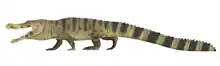
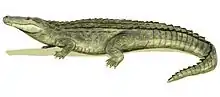
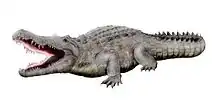
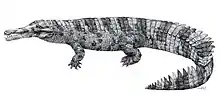
Acresuchus ("Acre crocodile") is an extinct genus of large caiman from the Late Miocene of western Brazil and of Venezuela. The genus contains a single species, A. pachytemporalis. Acresuchus is a close relative of the giant caiman Purussaurus.
| Acresuchus Temporal range: Late Miocene, | |
|---|---|
Scientific classification  | |
| Kingdom: | Animalia |
| Phylum: | Chordata |
| Class: | Reptilia |
| Order: | Crocodilia |
| Family: | Alligatoridae |
| Subfamily: | Caimaninae |
| Genus: | †Acresuchus Souza-Filho et al., 2018 |
| Type species | |
| †Acresuchus pachytemporalis Souza-Filho et al., 2018 | |
Description
Acresuchus is known from the holotype, UFAC-2507, a nearly complete skull, and several referred specimens, all of them being part of the back of the skull table. The holotype and four referred specimens were found in Niteroi, located in the Solimões Formation in the state of Acre. Acresuchus is named for the state it was found in, while the species name pachytemporalis refers to the extreme thickening of the squamosal bones in the holotype.[2] Another specimen, MCNUSB-PB-02FU-RS43, a fragment of a skull, was found in the middle member of the Urumaco formation in Venezuela.[3]
Acresuchus is diagnosed as a "Caimanine with a medium-sized body, teeth with smooth (non-serrated) carinae, orbits large in comparison with other caimanines, having roughly straight margins that are larger than the infratemporal fenestrae, circular external naris, posterior margin of the skull table transversely straight to slightly concave, posterolateral margin of squamosal upturned throughout the entire dorsal lateral margin with a dorsoventral expansion in the posterior portion of the eminence", with the last trait being a unique trait within the subfamily Caimaninae.[2]
The holotype of Acresuchus has an estimated skull length of 51.5 cm (20.3 in), smaller than all three species of Purussaurus, which suggests that Acresuchus may have represented a transitional form between the traditional caiman body-plan and that of Purussaurus. This is supported by Acresuchus lacking an enlarged external nostril, hypothesized to reduce stress to increase bite force in Purussaurus. Acresuchus has small depressions in the posterior portions of the maxillae which are similar to the deep depressions in Purussaurus, which suggests that these depressions may increase with body size in the Acresuchus-Purussaurus clade.[2]
Acresuchus simultaneously possesses traits shared with Purussaurus which may be adaptations to a larger body size, such as larger supratemporal fenestrae (openings) than other caimanines which correlates with a quick capture of prey and better thermoregulation.[2]
Classification
When Acresuchus was described, the authors of its description entered the data gleaned from its referred specimens into a phylogenetic analysis to test its affinities. It was found to be a member of Caimaninae closely related to Purussaurus,[2] which was confirmed by subsequent studies.[1] The result of the initial analysis is shown in the cladogram below.[2]
| Caimaninae |
| ||||||||||||||||||||||||||||||||||||||||||||||||||||||||||||||||||||||||||||||||||||||||||||||||||||||||||||||||||||||||||||||||||||||||||
Paleoecology
Acresuchus would have lived with several other crocodyliform species, such as its close relative Purussaurus and the giant gavialid Gryposuchus. Despite the fact that an age cannot be estimated for any specimen of Acresuchus, it shares several similarities with the living black caiman, including size. This may suggest that Acresuchus preyed on small invertebrates as a juvenile, with an adult preying on fish and small to medium-sized mammals. The teeth at the back of the skull in Acresuchus are blunt, indicating that it may have also preyed on hard-shelled animals occasionally.[2]
References
- Rio, Jonathan P.; Mannion, Philip D. (6 September 2021). "Phylogenetic analysis of a new morphological dataset elucidates the evolutionary history of Crocodylia and resolves the long-standing gharial problem". PeerJ. 9: e12094. doi:10.7717/peerj.12094. PMC 8428266. PMID 34567843.
- Souza-Filho, Jonas P.; Souza, Rafael G.; Hsiou, Annie Schmaltz; Riff, Douglas; Guilherme, Edson; Negri, Francisco Ricardo; Cidade, Giovanne M. (2018-09-03). "A new caimanine (Crocodylia, Alligatoroidea) species from the Solimões Formation of Brazil and the phylogeny of Caimaninae" (PDF). Journal of Vertebrate Paleontology. 38 (5): e1528450. doi:10.1080/02724634.2018.1528450. ISSN 0272-4634. S2CID 91964360.
- Cidade, Giovanne M.; Rincón, Ascanio Daniel (October 2021). "The first occurrence of Acresuchus (Alligatoroidea, Caimaninae) from the Urumaco Formation of Venezuela and the late Miocene crocodylian fauna of northern South America". Journal of South American Earth Sciences. 110: 103344. Bibcode:2021JSAES.11003344C. doi:10.1016/j.jsames.2021.103344. ISSN 0895-9811.
Extinct crocodilians | |||||||||||||||||||||||||||||||||||||||||
|---|---|---|---|---|---|---|---|---|---|---|---|---|---|---|---|---|---|---|---|---|---|---|---|---|---|---|---|---|---|---|---|---|---|---|---|---|---|---|---|---|---|
| |||||||||||||||||||||||||||||||||||||||||
| |||||||||||||||||||||||||||||||||||||||||
| |||||||||||||||||||||||||||||||||||||||||
| |||||||||||||||||||||||||||||||||||||||||
| |||||||||||||||||||||||||||||||||||||||||