Panoplosaurini
Panoplosaurini (derived from Panoplosaurus, "all shield reptile") is a clade of nodosaurid ankylosaurs from the Cretaceous of North America and South America. The group is defined as the largest clade containing Panoplosaurus mirus, but not Nodosaurus textilis or Struthiosaurus austriacus, and was named in 2021 by Madzia and colleagues for the group found in many previous analyses, both morphological and phylogenetic. Panoplosaurini includes not only the Late Cretaceous Panoplosaurus, Denversaurus and Edmontonia, but also the mid Cretaceous Animantarx and Texasetes, as well as an unnamed Argentinian taxon. The approximately equivalent clade Panoplosaurinae, named in 1929 by Franz Nopcsa, but was not significantly used until Robert Bakker reused the name in 1988, alongside the new clades Edmontoniinae and Edmontoniidae, which were considered to unite Panoplosaurus, Denversaurus and Edmontonia to the exclusion of other ankylosaurs. As none of the clades were commonly used, or formally named following the PhyloCode, Madzia et al. named Panoplosaurini instead, as the group of taxa fell within the clade Nodosaurinae, and having the same -inae suffix on both parent and child taxon could be confusing in future.[1] The 2018 phylogenetic analysis of Rivera-Sylva and colleagues was used as the primary reference for Panoplosaurini by Madzia et al., in addition to the supplemental analyses of Arbour et al. (2016), Brown et al. (2017), and Zheng et al. (2018).[1][2][3][4][5]
| Nodosaurinae |
| ||||||||||||||||||||||||||||||||||||||||||||||||||||||||||||||||||||||||||||||||||||
| Panoplosaurins | |
|---|---|
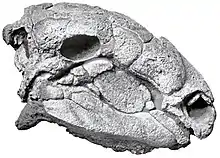 | |
| Skull of Panoplosaurus | |
Scientific classification  | |
| Kingdom: | Animalia |
| Phylum: | Chordata |
| Clade: | Dinosauria |
| Order: | †Ornithischia |
| Clade: | †Thyreophora |
| Suborder: | †Ankylosauria |
| Family: | †Nodosauridae |
| Subfamily: | †Nodosaurinae |
| Clade: | †Panoplosaurini Madzia et al., 2021[1] |
| Genera[1] | |
| Synonyms[1] | |
References
- Madzia, D.; Arbour, V.M.; Boyd, C.A.; Farke, A.A.; Cruzado-Caballero, P.; Evans, D.C. (2021). "The phylogenetic nomenclature of ornithischian dinosaurs". PeerJ. 9: e12362. doi:10.7717/peerj.12362. PMC 8667728. PMID 34966571.
- Rivera-Sylva, H.E.; Frey, E.; Stinnesbeck, W.; Carbot-Chanona, G.; Sanchez-Uribe, I.E.; Guzmán-Gutiérrez, J.R. (2018). "Paleodiversity of Late Cretaceous Ankylosauria from Mexico and their phylogenetic significance". Swiss Journal of Palaeontology. 137: 83–93. doi:10.1007/s13358-018-0153-1. S2CID 134924657.
- Arbour, V.M.; Zanno, L.E.; Gates, T. (2016). "Ankylosaurian dinosaur palaeoenvironmental associations were influenced by extirpation, sea-level fluctuation, and geodispersal". Palaeogeography, Palaeoclimatology, Palaeoecology. 449: 289–299. Bibcode:2016PPP...449..289A. doi:10.1016/j.palaeo.2016.02.033.
- Brown, C.M.; Henderson, D.M.; Vinther, J.; Fletcher, I.; Sistiaga, A.; Herrera, J.; Summons, R.E. (2017). "An Exceptionally Preserved Three-Dimensional Armored Dinosaur Reveals Insights into Coloration and Cretaceous Predator-Prey Dynamics". Current Biology. 27 (16): 2514–2521. doi:10.1016/j.cub.2017.06.071. PMID 28781051. S2CID 5182644.
- Zheng, W.; Jin, X.; Azuma, Y.; Wang, Q.; Miyata, K.; Xu, X. (2018). "The most basal ankylosaurine dinosaur from the Albian–Cenomanian of China, with implications for the evolution of the tail club". Scientific Reports. 8 (1): 3711. Bibcode:2018NatSR...8.3711Z. doi:10.1038/s41598-018-21924-7. PMC 5829254. PMID 29487376.
| |||||||||||||||||||||||||||||||||||||||||||
| |||||||||||||||||||||||||||||||||||||||||||
| |||||||||||||||||||||||||||||||||||||||||||
| |||||||||||||||||||||||||||||||||||||||||||