Nodosaurus
Nodosaurus (meaning "knobbed lizard") is a genus of herbivorous nodosaurid ankylosaurian dinosaur from the Late Cretaceous, the fossils of which are found in North America.
| Nodosaurus Temporal range: Late Cretaceous, | |
|---|---|
_(17529968373).jpg.webp) | |
| Vertebrae and armor of the holotype | |
Scientific classification  | |
| Kingdom: | Animalia |
| Phylum: | Chordata |
| Clade: | Dinosauria |
| Order: | †Ornithischia |
| Clade: | †Thyreophora |
| Suborder: | †Ankylosauria |
| Family: | †Nodosauridae |
| Subfamily: | †Nodosaurinae |
| Genus: | †Nodosaurus Marsh, 1889 |
| Type species | |
| †Nodosaurus textilis | |
Description
_(18147021802).jpg.webp)
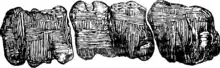
This nodosaurid ankylosaur was about 4 to 6 metres (13 to 20 ft) long. It was an ornithischian dinosaur with bony dermal plates covering the top of its body, and it may have had spikes along its side as well. The dermal plates were arranged in bands along its body, with narrow bands over the ribs alternating with wider plates in between. These wider plates were covered in regularly arranged bony nodules, which give the animal its scientific name.[1] In 2010 Paul estimated its length at 6 meters (20 ft) and its weight at 3.5 tonnes (3.85 short tons).[2]
It had four short legs, five-toed feet, a short neck, and a long, stiff, clubless tail. The head was narrow, with a pointed snout, powerful jaws, and small teeth.[1] It perhaps ate soft plants, as it would have been unable to chew tough, fibrous ones; or alternatively it may have processed the latter with gastroliths and its enormous intestinal apparatus.
History and classification
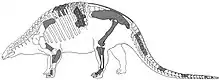
During the Bone Wars between paleontologists Othniel Charles Marsh and Edward Drinker Cope, Marsh sent his collector William Harlow Reed to the Cenomanian strata of the Frontier Formation of Albany County, Wyoming to collect fossil mammals and reptiles.[3] Reed collected a partial postcranial skeleton (YPM VP 1815) on July 17, 1881 southeast of the productive Quarry 13, the skeleton including: 3 dorsal and 13 caudal vertebrae, 3 dorsal ribs, fragmentary forelimbs, a partial pelvis, femora, tibiae, partial left pes, and several osteoderms.[4][5] One of the first armored dinosaurs to be discovered in North America, Nodosaurus textilis was named by Othniel Charles Marsh in 1889, the generic name meaning "knobbed lizard" and the specific name meaning "woven".[6][7] Marsh assigned to genus to Stegosauria, but later assigned it to its own family, Nodosauridae, in 1890 based on the heavy dermal armor, solid bones, large forelimbs, and ungulate feet.[8] The type specimen remains the only definite specimen of Nodosaurus, though Stegopelta has been considered a synonym in the past,[5] it is most likely a distinct Struthiosaurinine.[4][9] Richard Swan Lull did a more comprehensive description of Nodosaurus in 1921, who assigned the taxa Stegopelta, Hoplitosaurus, Hierosaurus, Ankylosaurus, and placed the British Polacanthus as a relative of the family.[6]
The 2018 phylogenetic analysis of Rivera-Sylva and colleagues is below.[9]
| Nodosauridae |
| |||||||||||||||||||||||||||||||||||||||||||||||||||||||||||||||||||||||||||||||||||||||||||||||||||||||||||||||||||||||||||||||||||||||||||||||||||||||||
See also
References
- Palmer, D., ed. (1999). The Marshall Illustrated Encyclopedia of Dinosaurs and Prehistoric Animals. London: Marshall Editions. pp. 158–159. ISBN 1-84028-152-9.
- Paul, Gregory S. (2010). The Princeton Field Guide to Dinosaurs. New Jersey: Princeton University Press. p. 236.
- Weishampel, David B; et al. (2004). "Dinosaur distribution (Late Cretaceous, North America)." In: Weishampel, David B.; Dodson, Peter; and Osmólska, Halszka (eds.): The Dinosauria, 2nd, Berkeley: University of California Press. Pp. 574-588. ISBN 0-520-24209-2.
- Raven, T. J. (2021). The Taxonomic, Phylogenetic, Biogeographic and Macroevolutionary History of the Armoured Dinosaurs (Ornithischia: Thyreophora)(Doctoral dissertation, University of Brighton).
- Coombs, Jr. (1978). "The families of the ornithischian dinosaur order Ankylosauria". Palaeontology. 21 (1): 143–170.
- Lull, R. S. (1921). The Cretaceous armored dinosaur, Nodosaurus textilis Marsh.
- O. C. Marsh. 1889. Notice of gigantic horned Dinosauria from the Cretaceous. American Journal of Science 38:173-175
- Marsh, O. C. (1890). Description of new dinosaurian reptiles. American Journal of Science, 3(229), 81-86. Chicago
- Rivera-Sylva, Héctor E.; Frey, Eberhard; Stinnesbeck, Wolfgang; Carbot-Chanona, Gerardo; Sanchez-Uribe, Iván E.; Guzmán-Gutiérrez, José Rubén (2018). "Paleodiversity of Late Cretaceous Ankylosauria from Mexico and their phylogenetic significance". Swiss Journal of Palaeontology. 137 (1): 83–93. doi:10.1007/s13358-018-0153-1. ISSN 1664-2384.
 |
Wikisource has original text related to this article: |
 |
Wikispecies has information related to Nodosaurus. |
| |||||||||||||||||||||||||||||||||||||||||||
| |||||||||||||||||||||||||||||||||||||||||||
| |||||||||||||||||||||||||||||||||||||||||||
| |||||||||||||||||||||||||||||||||||||||||||