Pteranodontia
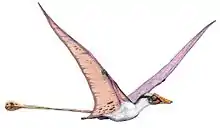
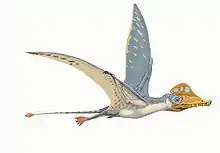
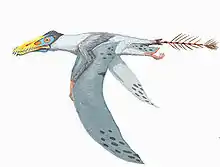
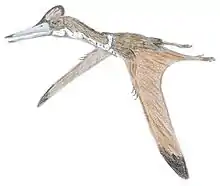
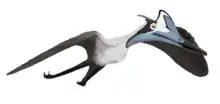
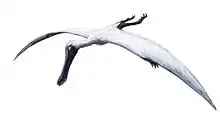
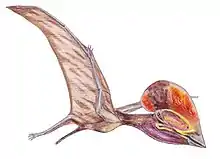
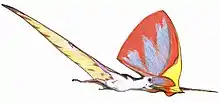
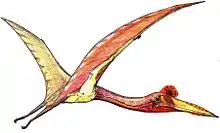
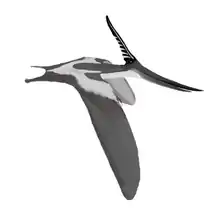
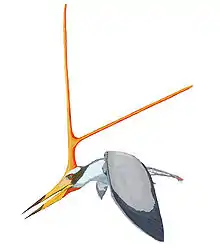
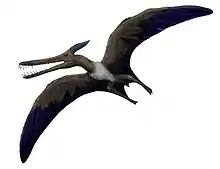
Pteranodontia is an extinct group of ornithocheiroid pterodactyloid pterosaurs that lived during the Late Cretaceous period (Coniacian to Maastrichtian stages) of North America and Africa.[1] They were some of the most advanced pterosaurs, and possessed highly specialized cranial crests that may have served as sexual attraction, with males having a much larger crest.
| Pteranodontians | |
|---|---|
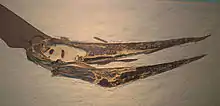 | |
| Skull specimen (AMNH 7515) of the pteranodontid Pteranodon longiceps | |
 | |
| Skull cast of the nyctosaurid Nyctosaurus gracilis | |
Scientific classification  | |
| Kingdom: | Animalia |
| Phylum: | Chordata |
| Order: | †Pterosauria |
| Suborder: | †Pterodactyloidea |
| Clade: | †Pteranodontoidea |
| Clade: | †Pteranodontia Marsh, 1887 |
| Subgroups | |
| |
| Synonyms | |
| |
Classification
Pteranodontia was originally named by Marsh in 1876. In 2003, it was given a phylogenetic definition by David Unwin as the common ancestor of Pteranodon and Nyctosaurus plus all its descendants. Though Marsh had originally named this group based on the shared absence of teeth in those species, most analyses show that all of the traditional "ornithocheiroid" pterosaurs are also members of this clade.
Below is a cladogram showing the phylogenetic placement of this group from Andres and Myers (2013).[2]
| Pteranodontia |
| |||||||||||||||||||||||||||||||||||||||||||||||||||||||||||||||||||||||||||||||||||||||||||||||||||||||||||||||||||||||||||||||||||||||||||||
In 2018, Longrich, Martill, and Andres revisited the classification, and made a different phylogenetic analysis. In the analysis, they followed Marsh's original classification, in which Pteranodontia is restricted to the families Pteranodontidae and Nyctosauridae. They also replaced Pteranodontia with Pteranodontoidea as the more inclusive group.[3]
| Ornithocheiroidea |
| |||||||||||||||||||||||||||||||||||||||||||||||||||||||||||||||||||||||||||||||||||||||||||||||||||||||||||||||
Paleobiology
Locomotion
Similar to other pterosaurs, pteranodontian are considered to have been skilled fliers as well as adept at moving on the ground. Evidence from footprints shows that most pterosaurs did not sprawl their limbs to a large degree, as in modern reptiles, but rather held the limbs relatively erect when walking, like dinosaurs. Footprints of pteranodontians are still unknown, but it is likely that they also walked erect.[4] Among pterosaurs, pteranodontians had unusually uneven limb proportions, with the forelimbs much larger and longer than the hind limbs. This would likely have required them to use unique modes of locomotion when on the ground compared to other pterosaurs. Most pteranodontians like Pteranodon flew like modern day albatrosses, which consists of flying very long distances and rarely flapping.[5][6]
"Wyomingopteryx"
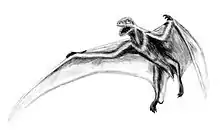
The name "Wyomingopteryx" appears in a painting of Morrison prehistoric animals by Robert Bakker. However, this binomen is a nomen nudum, and it is possible that Bakker may have intended to coin "Wyomingopteryx" for the Istiodactylus-like specimen TATE 5999 because that specimen is found in Wyoming.[7][8]
References
- Richard J. Butler; Stephen L. Brusatte; Brian B. Andres; Roger B. J. Benson (2012). "How do geological sampling biases affect studies of morphological evolution in deep time? A case study of the Pterosauria (Reptilia: Archosauria)". Evolution. 66 (1): 147–162. doi:10.1111/j.1558-5646.2011.01415.x. PMID 22220871. S2CID 205783384.
- Andres, B.; Myers, T. S. (2013). "Lone Star Pterosaurs". Earth and Environmental Science Transactions of the Royal Society of Edinburgh. 103 (3–4): 1. doi:10.1017/S1755691013000303. S2CID 84617119.
- Longrich, N.R., Martill, D.M., and Andres, B. (2018). Late Maastrichtian pterosaurs from North Africa and mass extinction of Pterosauria at the Cretaceous-Paleogene boundary. PLoS Biology, 16(3): e2001663. doi:10.1371/journal.pbio.2001663
- Witton, M.P.; Habib, M.B. (2010). "On the Size and Flight Diversity of Giant Pterosaurs, the Use of Birds as Pterosaur Analogues and Comments on Pterosaur Flightlessness". PLOS ONE. 5 (11): e13982. doi:10.1371/journal.pone.0013982. PMC 2981443. PMID 21085624.
- Habib, M. (2011). "Dinosaur Revolution: Anhanguera." H2VP: Paleobiomechanics. Weblog entry, 20-SEP-2011. Accessed 28-SEP-2011: http://h2vp.blogspot.com/2011/09/dinosaur-revolution-anhanguera.html
- Witton, Mark (2013). Pterosaurs: Natural History, Evolution, Anatomy. Princeton University Press. ISBN 978-0691150611.
- Bakker, R.T. (1994) Unearthing the Jurassic. In: Science Year 1995. World Book Inc.:Chicago, London, Sydney, Toronto, 76-89. ISBN 0-7166-0595-3.
- Bakker, R.T. (1998). "Dinosaur mid-life crisis: the Jurassic-Cretaceous transition in Wyoming and Colorado". In Lucas, Spencer G.; Kirkland, James I.; Estep, J.W. Lower and Middle Cretaceous Terrestrial Ecosystems 14. New Mexico Museum of Natural History and Science Bulletin. pp. 67–77.