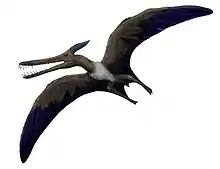
Aerodraco
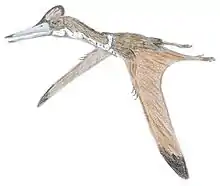
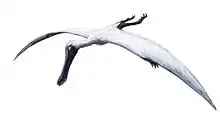
Aerodraco (meaning "air dragon") is a genus of anhanguerid pterosaur from the Albian–Cenomanian-age Cambridge Greensand of England. It contains only one species, Aerodraco sedgwickii. It was originally assigned to the genus Pterodactylus.[1]
| Aerodraco Temporal range: Albian–Cenomanian, ~ | |
|---|---|
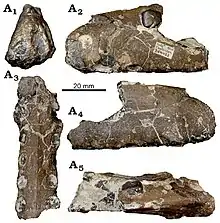 | |
| Holotype snout in multiple views | |
Scientific classification  | |
| Kingdom: | Animalia |
| Phylum: | Chordata |
| Order: | †Pterosauria |
| Suborder: | †Pterodactyloidea |
| Clade: | †Ornithocheirae |
| Clade: | †Anhangueria |
| Family: | †Anhangueridae |
| Genus: | †Aerodraco Holgado & Pêgas, 2020 |
| Type species | |
| †Pterodactylus sedgwickii Owen, 1859 | |
| Species | |
| |
| Synonyms | |
| |
Discovery and naming
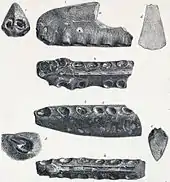
In 1859, Sir Richard Owen named pterosaur material from the Cambridge Greensand of England as Pterodactylus sedgwickii.[2] At the time, Pterodactylus was a wastebasket taxon; all sorts of unrelated pterosaurs were assigned to that genus. In 1870, Harry Seeley reassigned it to Ornithocheirus, another wastebasket taxon. Its specific name honors Adam Sedgwick.[3] It was in 1869 renamed by Seeley into a Ptenodactylus sedgwickii,[4] and in 1870 into a Ornithocheirus sedgwickii (by then it has been placed within the now obsolete Ornithosauria).[5] In 1874, Owen again renamed it into Coloborhynchus sedgwickii.[6] Owen in 1859 also referred a front of the lower jaws, specimen CAMSM B54421. However, this piece is not of the same individual as the holotype and there is no proof for any connection with Pterodactylus sedgwickii.[7]
It was then largely ignored in modern literature until 2013, when Rodrigues and Kellner assigned it to their new genus Camposipterus. However, even they were unsure of this placement, calling it Camposipterus(?) sedgwickii.[7] Finally, in 2020, Holgado and Pêgas assigned it to its own genus, Aerodraco; the genus name means "air dragon", in reference to the 1901 book Dragons of the Air by Harry Seeley.
Description
Rodrigues & Kellner established two autapomorphies of Camposipterus(?) sedgwickii. The expanded section of the front snout is suddenly constricted behind the third tooth pair. The tooth sockets of the third tooth pair are much larger than those of the fourth pair. There is a unique combination of traits: the snout is deep; the midline ridge on the palate towards the front reaches a position behind the third tooth pair, which distinguishes Aerodraco from Camposipterus.[1]
Classification
In 2020, Holgado & Pêgas placed Aerodraco in the subfamily Coloborhynchinae, which they placed in the family Anhangueridae. They found it completely unrelated to Pterodactylus, the genus Aerodraco was originally placed within during 1859. The cladogram below shows their phylogenetic analysis.[1]
| Anhangueridae |
| |||||||||||||||||||||||||||||||||||||||||||||||||||||||||||||||||||||||||||
References
- Holgado, B.; Pêgas, R.V. (2020). "A taxonomic and phylogenetic review of the anhanguerid pterosaur group Coloborhynchinae and the new clade Tropeognathinae". Acta Palaeontologica Polonica. 65. doi:10.4202/app.00751.2020.
- R. Owen. 1859. Supplement (No. I) to the Monograph on the Fossil Reptilia of the Cretaceous Formations. Palaeontographical Society Monographs 1–19
- Owen, R., 1859, Monograph on the fossil Reptilia of the Cretaceous formations. Supplement no. I. Palaeontographical Society, London, 19 pp
- Seeley, H.G., 1869, Index to the fossil remains of Aves, Ornithosauria, and Reptilia, from the Secondary System of Strata arranged in the Woodwardian Museum of the University of Cambridge. Deighton, Bell and Co., Cambridge, xxiii + 143 pp
- Seeley, H.G., 1870, The Ornithosauria: an elementary study of the bones of pterodactyls, made from fossil remains found in the Cambridge Upper Greensand, and arranged in the Woodwardian Museum of the University of Cambridge. Deighton, Bell, and Co., Cambridge, xii + 135 pp
- Owen, R., 1874, Monograph on the fossil Reptilia of the Mesozoic Formations. Palaeontographical Society, London, 14 pp
- Rodrigues, T.; Kellner, A. (2013). "Taxonomic review of the Ornithocheirus complex (Pterosauria) from the Cretaceous of England". ZooKeys (308): 1–112. doi:10.3897/zookeys.308.5559. PMC 3689139. PMID 23794925.