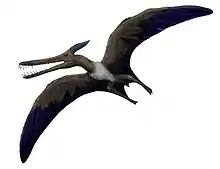
Istiodactylidae
Istiodactylidae is a small family of pterosaurs. This family was named in 2001 after the type genus Istiodactylus was discovered not to be a member of the genus Ornithodesmus.
| Istiodactylids Temporal range: Early Cretaceous, Possible Middle Jurassic record | |
|---|---|
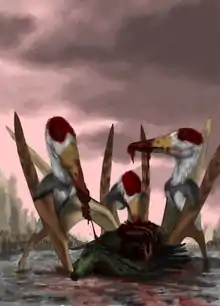 | |
| Life restoration of Istiodactylus latidens feeding on a stegosaur corpse. | |
Scientific classification  | |
| Kingdom: | Animalia |
| Phylum: | Chordata |
| Order: | †Pterosauria |
| Suborder: | †Pterodactyloidea |
| Clade: | †Lanceodontia |
| Clade: | †Istiodactyliformes |
| Family: | †Istiodactylidae Howse, Milner & Martill, 2001 |
| Type species | |
| †Ornithodesmus latidens Hooley, 1913 | |
| Genera | |
| |
Systematics and distribution
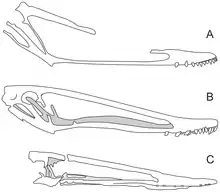
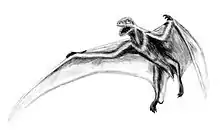
Remains of taxa that can be confidently assigned to Istiodactylidae have been found in the UK and China, in rocks dating from the Early Cretaceous period (Barremian to Aptian stage).[2] Arbour and Currie (2011) described Canadian Gwawinapterus beardi as a member of Istiodactylidae living in the late Cretaceous (upper Campanian stage);[3] however, Witton (2012) suggested the tooth replacement pattern in this animal does not match that of pterosaurs, suggesting that the species might be non-pterosaurian.[2] Additional research suggested that the species was in fact a fish.[4] The earliest known species might be Archaeoistiodactylus linglongtaensis, from the Middle Jurassic of China;[5] however, it also has been suggested that the holotype specimen of this species might actually be a poorly preserved specimen of Darwinopterus.[6] Hongshanopterus, a supposed istiodactylid from China, has been reclassified as a non-istiodactylid member of Ornithocheiroidea of uncertain phylogenetic placement by Witton (2012).[2]
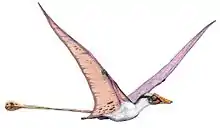
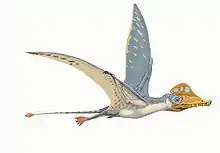
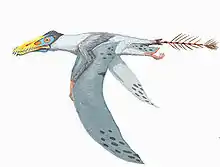
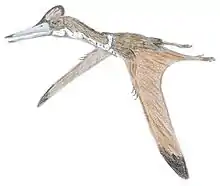
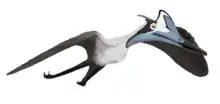
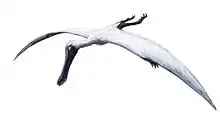
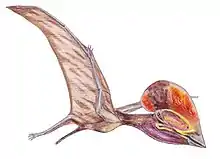
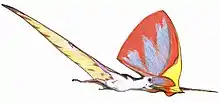
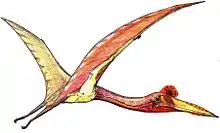
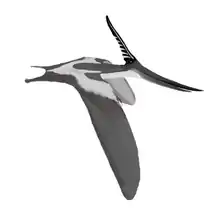
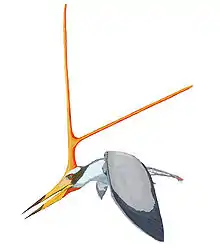
Istiodactylids were medium-sized pterosaurs with flat, rounded jaws similar to that of a duck. They had small teeth lining their jaws, however, and this can mostly be seen in the more advanced genera such as Istiodactylus.[7]
Classification
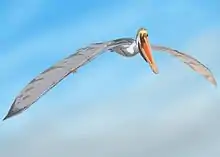
Below is a cladogram showing the phylogenetic placement of this group within Pteranodontia from Andres and Myers (2013).[8]
| Pteranodontia |
| |||||||||||||||||||||||||||||||||||||||||||||||||||||||||||||||||||||||||||||||||||||||||||||||||||||||||||||||||||||||||||||||||||||||||||||
The cladogram below is a topology recovered by Kellner et al. (2019). In the analyses, they recovered Istiodactylidae within the more inclusive group Istiodactyliformes, and assigned both Istiodactylus and Liaoxipterus to a new subfamily called Istiodactylinae, but kept Nurhachius as a basal member.[9]
| Istiodactyliformes |
| ||||||||||||||||||||||||||||||
Paleobiology
Lifestyle
Unlike most ornithocheiroids, istiodactylids bear physiologies suited to a terrestrial life and many of their fossils have been found in freshwater-deposits. Istiodactylids are considered to be pterosaurian equivalents to vultures: acting as the clean-up crew in their native locations. Whether or not istiodactylids could swim like most water-loving pterosaurs remains a mystery.
References
 |
Wikispecies has information related to Istiodactylidae. |
- Hone, David W. E., Fitch, Adam J., Ma, Feimin, and Xu, Xing. 2020. An unusual new genus of istiodactylid pterosaur from China based on a near complete specimen. Palaeontologia Electronica 23(1):a09. https://doi.org/10.26879/1015 palaeo-electronica.org/content/2020/2931-a-new-istiodactylid-pterosaur
- Mark P. Witton (2012). "New Insights into the Skull of Istiodactylus latidens (Ornithocheiroidea, Pterodactyloidea)". PLOS ONE. 7 (3): e33170. Bibcode:2012PLoSO...733170W. doi:10.1371/journal.pone.0033170. PMC 3310040. PMID 22470442.
- Arbour V.M.; Currie P.J. (2011). "An istiodactylid pterosaur from the Upper Cretaceous Nanaimo Group, Hornby Island, British Columbia, Canada". Canadian Journal of Earth Sciences. 48 (1): 63–69. Bibcode:2011CaJES..48...63S. doi:10.1139/E10-083.
- Vullo R.; Buffetaut E.; Everhart M.J. (2012). "Reappraisal of Gwawinapterus beardi from the Late Cretaceous of Canada: a saurodontid fish, not a pterosaur". Journal of Vertebrate Paleontology. 32 (5): 1198–1201. doi:10.1080/02724634.2012.681078. S2CID 129180570.
- Lü J.; Fucha X. (2010). "A new pterosaur (Pterosauria) from Middle Jurassic Tiaojishan Formation of western Liaoning, China". Global Geology. Z1: 113–118.
- David M. Martill & Steve Etches (2012). "A new monofenestratan pterosaur from the Kimmeridge Clay Formation (Upper Jurassic, Kimmeridgian) of Dorset, England". Acta Palaeontologica Polonica. in press. doi:10.4202/app.2011.0071.
- Witton, Mark P. (2012). "New Insights into the Skull of Istiodactylus latidens (Ornithocheiroidea, Pterodactyloidea)". PLOS ONE. 7 (3): e33170. Bibcode:2012PLoSO...733170W. doi:10.1371/journal.pone.0033170. PMC 3310040. PMID 22470442.
- Andres, B.; Myers, T. S. (2013). "Lone Star Pterosaurs". Earth and Environmental Science Transactions of the Royal Society of Edinburgh. 103 (3–4): 1. doi:10.1017/S1755691013000303. S2CID 84617119.
- Kellner, Alexander W. A.; Caldwell, Michael W.; Holgado, Borja; Vecchia, Fabio M. Dalla; Nohra, Roy; Sayão, Juliana M.; Currie, Philip J. (2019). "First complete pterosaur from the Afro-Arabian continent: insight into pterodactyloid diversity". Scientific Reports. 9 (1): 17875. Bibcode:2019NatSR...917875K. doi:10.1038/s41598-019-54042-z. PMC 6884559. PMID 31784545.