Carnotaurinae
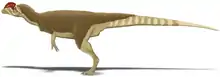
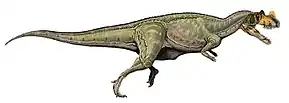
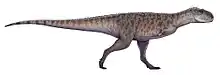
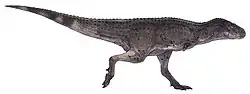
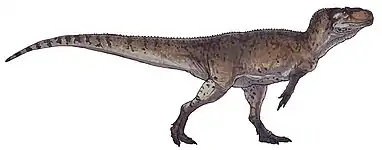
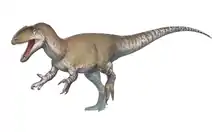
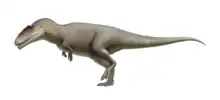
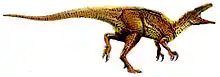
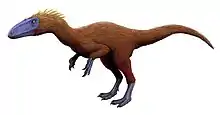
Carnotaurinae is a subfamily of the theropod dinosaur family Abelisauridae. It includes the dinosaurs Aucasaurus (from Argentina), Carnotaurus (from Argentina), and Rajasaurus (from India). The group was first proposed by American paleontologist Paul Sereno in 1998, defined as a clade containing all abelisaurids more closely related to Carnotaurus than to Majungasaurus.[1]
| Carnotaurines Temporal range: Late Cretaceous, | |
|---|---|
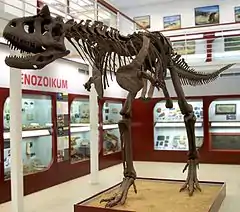 | |
| Mounted cast of a Carnotaurus sastrei skeleton, Chlupáč Museum, Prague | |
Scientific classification  | |
| Kingdom: | Animalia |
| Phylum: | Chordata |
| Clade: | Dinosauria |
| Clade: | Saurischia |
| Clade: | Theropoda |
| Family: | †Abelisauridae |
| Subfamily: | †Carnotaurinae Sereno, 1998 |
| Type species | |
| †Carnotaurus sastrei Bonaparte, 1985 | |
| Subgroups | |
Classification
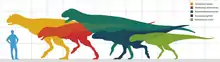
- Subfamily Carnotaurinae[2]
- Brachyrostra
- Ekrixinatosaurus (Argentina)[3]
- Ilokelesia (Argentina)[3]
- Skorpiovenator (Argentina)[3]
- Thanos (Brazil)[4]
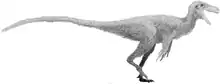
- Furileusauria
- ?Niebla (Argentina)
- Llukalkan (Argentina)
- Viavenator (Argentina)
- Pycnonemosaurus (Brazil)
- Quilmesaurus (Argentina)[5]
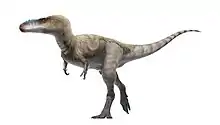
- Carnotaurini
- Carnotaurus (Argentina)
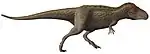
- Abelisaurinae
- Aucasaurus (Argentina)
- Abelisaurus (Argentina)
- Brachyrostra
Phylogeny
In 2008, Canale et al. published a phylogenetic analysis focusing on the South American carnotaurines. In their results, they found that all South American forms (including Ilokelesia) grouped together as a sub-clade of Carnotaurinae, which they named Brachyrostra, meaning "short snouts." They defined the clade Brachyrostra as "all the abelisaurids more closely related to Carnotaurus sastrei than to Majungasaurus crenatissimus."[3]
| Carnotaurinae |
| ||||||||||||||||||||||||||||||
An analysis conducted by Tortosa et al. in 2013 moved several carnotaurine taxa into the newly named Majungasaurinae, and moved many abelisaurids into Carnotaurini.
| Abelisauridae |
| ||||||||||||||||||||||||||||||||||||||||||||||||||||||||||||||||||||||||||||||||||||
See also
References
- Sereno, Paul C. (10 November 1998). "A rationale for phylogenetic definitions, with application to the higher-level taxonomy of Dinosauria". Neues Jahrbuch für Geologie und Paläontologie - Abhandlungen. 210 (1): 41–83. doi:10.1127/njgpa/210/1998/41.
- Delcourt, Rafael (27 June 2018). "Ceratosaur palaeobiology: new insights on evolution and ecology of the southern rulers". Scientific Reports. 8 (1): 9730. Bibcode:2018NatSR...8.9730D. doi:10.1038/s41598-018-28154-x. PMC 6021374. PMID 29950661.
- Canale, Juan I.; Scanferla, Carlos A.; Agnolin, Federico L.; Novas, Fernando E. (5 December 2008). "New carnivorous dinosaur from the Late Cretaceous of NW Patagonia and the evolution of abelisaurid theropods". Naturwissenschaften. 96 (3): 409–414. Bibcode:2009NW.....96..409C. doi:10.1007/s00114-008-0487-4. hdl:11336/52024. PMID 19057888.
- Delcourt, Rafael; Iori, Fabiano Vidoi (16 November 2018). "A new Abelisauridae (Dinosauria: Theropoda) from São José do Rio Preto Formation, Upper Cretaceous of Brazil and comments on the Bauru Group fauna". Historical Biology: 1–8. doi:10.1080/08912963.2018.1546700.
- Tortosa, Thierry; Buffetaut, Eric; Vialle, Nicolas; Dutour, Yves; Turini, Eric; Cheylan, Gilles (January 2014). "A new abelisaurid dinosaur from the Late Cretaceous of southern France: Palaeobiogeographical implications". Annales de Paléontologie. 100 (1): 63–86. doi:10.1016/j.annpal.2013.10.003.
Further reading
- Sampson, S. D. (15 May 1998). "Predatory Dinosaur Remains from Madagascar: Implications for the Cretaceous Biogeography of Gondwana" (PDF). Science. 280 (5366): 1048–1051. Bibcode:1998Sci...280.1048S. doi:10.1126/science.280.5366.1048. PMID 9582112. Archived from the original (PDF) on 23 February 2019.
- Lamanna, Matthew C.; Martínez, Rubén D.; Smith, Joshua B. (14 March 2002). "A definitive abelisaurid theropod dinosaur from the early Late Cretaceous of Patagonia". Journal of Vertebrate Paleontology. 22 (1): 58–69. doi:10.1671/0272-4634(2002)022[0058:ADATDF]2.0.CO;2.
| |||||||||||||||||||||||||||||||||||||||||||||||||||||||||
| |||||||||||||||||||||||||||||||||||||||||||||||||||||||||
| |||||||||||||||||||||||||||||||||||||||||||||||||||||||||
| |||||||||||||||||||||||||||||||||||||||||||||||||||||||||
| |||||||||||||||||||||||||||||||||||||||||||||||||||||||||
| |||||||||||||||||||||||||||||||||||||||||||||||||||||||||
| |||||||||||||||||||||||||||||||||||||||||||||||||||||||||
.jpg.webp)
.jpg.webp)
.png.webp)
.jpg.webp)