Austroposeidon
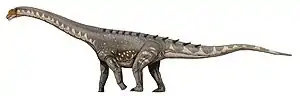
Austroposeidon is an extinct genus of titanosaurian sauropod dinosaur from the Late Cretaceous Presidente Prudente Formation of Brazil. It contains one species, Austroposeidon magnificus.[1]
| Austroposeidon | |
|---|---|
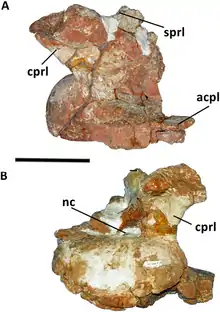 | |
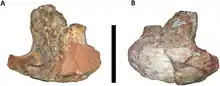
| Twelfth neck vertebra | |
Scientific classification  | |
| Kingdom: | Animalia |
| Phylum: | Chordata |
| Clade: | Dinosauria |
| Clade: | Saurischia |
| Clade: | †Sauropodomorpha |
| Clade: | †Sauropoda |
| Clade: | †Macronaria |
| Clade: | †Titanosauria |
| Clade: | †Lithostrotia |
| Genus: | †Austroposeidon Bandeira et al., 2016 |
| Species: | †A. magnificus |
| Binomial name | |
| †Austroposeidon magnificus Bandeira et al., 2016 | |
Description
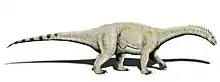
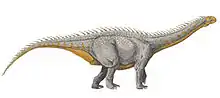
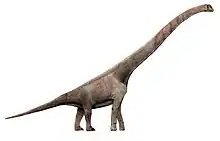
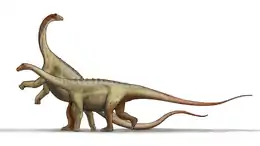
Austroposeidon was a large sauropod in fact, the largest dinosaur discovered in Brazil to date, with the only known specimen, an adult, having a length of about 25 metres (82 ft).[1]
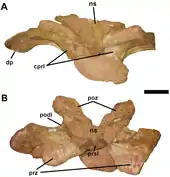
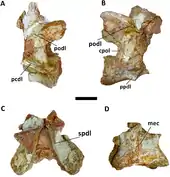
Several traits show that Austroposeidon was a member of the titanosaurs; the hyposphene-hypantrum articulations are missing from the vertebrae, the cervical and dorsal vertebrae do not have forked neural spines, and the internal texture of the bone is camellate (punctuated by many small air chambers). The describers determined that Austroposeidon was a new genus based on a number of autapomorphies (or traits unique to the known fossils) in the vertebrae: the thirteenth cervical vertebra has columnar centropostzygapophyseal laminae, and its rear centrodiapophyseal lamina splits into two prongs; the first dorsal vertebra has front and back centrodiapophyseal laminae that curve downwards and outwards, and its diapophysis stretches down to the top margin of the centrum; and the frontmost part of the spinoprezygapophyseal laminae forks in the dorsal vertebrae positioned towards the back of the torso. Additionally, Austroposeidon possesses a unique combination of other vertebral traits, not seen elsewhere among titanosaurs.[1]
A CT scan showed that the internal bone texture of the vertebrae possessed concentric, alternating rings of camellate tissue and dense tissue; the describers interpreted these as rings of growth within the bone.[1]
Discovery and naming
Austroposeidon is known from a single specimen, MCT 1628-R, which consists portions of the cervical (neck), dorsal, and sacral vertebrae (including a cervical rib and one complete dorsal vertebra). The specimen was discovered in the Campanian-Maastrichtian Presidente Prudente Formation of the Bauru Group by palaeontologist Llewellyn Ivor Price in 1953, but the remains were not described until 2016. The animal was likely preserved by a crevasse splay on a floodplain, judging by the fine sandstone that the specimen was found in. Unfortunately, the site where the specimen was recovered has now been lost to urban development.[1]
The genus name combines austro ("southern", as in South America, from Latin Auster, the southern wind) and poseidon, a reference to the Greek god of earthquakes of the same name. The specific name is the Latin word magnificus ("great, elevated, noble"), referring to the large size of the specimen.[1]
Classification
A phylogenetic analysis in 2016 recovered Austroposeidon as the sister taxon of the Lognkosauria.[1] An updated version was published by Silva et al. (2019), where the only significant changes from the original, based on a redescription of Uberabatitan, was the movement of Uberabatitan and Brasilotitan from Saltasaurinae to Aeolosaurini.[2]
| Titanosauria |
| ||||||||||||||||||||||||||||||||||||||||||||||||||||||||||||||||||||||||||||||||||||||||||||||||||||||||||||||||||||||||||||||||||||||||||||||||||||||||||||||||||||||||||||||
See also
References
- Bandeira, K.L.N.; Medeiros Simbras, F.; Batista Machado, E.; de Almeida Campos, D.; Oliveira, G.R.; Kellner, A.W.A. (2016). "A New Giant Titanosauria (Dinosauria: Sauropoda) from the Late Cretaceous Bauru Group, Brazil". PLOS ONE. 11 (10): e0163373. Bibcode:2016PLoSO..1163373B. doi:10.1371/journal.pone.0163373. PMC 5051738. PMID 27706250.
- Silva, J.C.G. Jr.; Marinho, T.S.; Martinelli, A.G.; Langer, M.C. (2019). "Osteology and systematics of Uberabatitan ribeiroi (Dinosauria; Sauropoda): a Late Cretaceous titanosaur from Minas Gerais, Brazil". Zootaxa. 4577 (3): 401–438. doi:10.11646/zootaxa.4577.3.1. PMID 31715707.