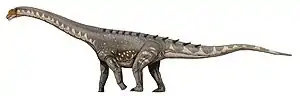
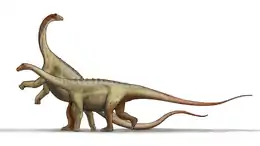
Abdarainurus
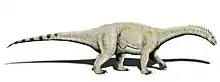
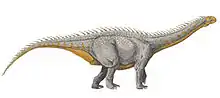
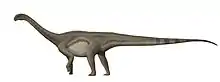
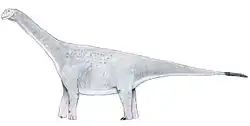
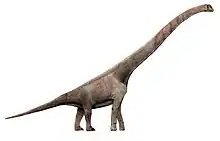
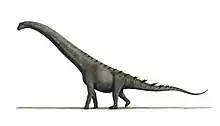
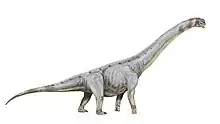
Abdarainurus (meaning "Abdrant Nuru tail" after the holotype locality) is a genus of titanosaur dinosaur from the Alagteeg Formation in Mongolia. The type and only species is A. barsboldi. Currently seen as an indeterminate titanosaur, it may represent a previously unknown lineage of Asian macronarians.[1] Abdarainurus is not known from many remains; it is only known from eight front tail vertebrae and a middle tail vertebra and several chevrons.
| Abdarainurus Temporal range: Late Cretaceous | |
|---|---|
Scientific classification  | |
| Kingdom: | Animalia |
| Phylum: | Chordata |
| Clade: | Dinosauria |
| Clade: | Saurischia |
| Clade: | †Sauropodomorpha |
| Clade: | †Sauropoda |
| Clade: | †Macronaria |
| Clade: | †Titanosauria |
| Genus: | †Abdarainurus Averianov & Lopatin, 2020 |
| Type species | |
| †Abdarainurus barsboldi Averianov & Lopatin, 2020 | |
Discovery and naming
The holotype, PIN 5669/1, was discovered in 1970 in Abdrant Nuru, hence the genus name, during a Joint Soviet–Mongolian Paleontological expedition and was excavated by V. P. Tverdokhlebov of Saratov State University. The fossils were left unprepared until at least 2000, when paleontologist Andrei Podlesnow revealed that they probably belonged to a new genus of sauropod.[2] The species Abdarainurus barsboldi was named in February 2020.[1]
Paleoecology
Abdarainurus was discovered in the Abdarant Nuru locality of the Alagteeg Formation (which may be the same unit as the overlying Djadochta Formation)[3] of Mongolia[1] and coexisted with the ankylosaur Pinacosaurus sp., and indeterminate turtles and dinosaurs.
Classification
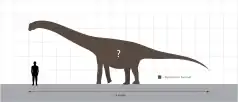
Abdarainurus was added to the phylogenetic analysis of Mannion and colleagues by Averianov and Lopatin, who ran the matrix under three different conditions. With all characters treated as equally important, Abdarainurus resolved as a non-titanosaur member of Somphospondyli, in a large polytomy with a variety of taxa. The more labile characters treated as slightly, or significantly, less important, Abdarainurus was either a basal titanosaur in a clade with Andesaurus and Huabeisaurus or as a member of Aeolosaurinae, respectively. As Abdarainurus was resolved with the fewest unique features as a basal titanosaur, Averianov and Lopatin suggested that phylogenetic result was the most likely, shown below.[1]
| Titanosauria |
| |||||||||||||||||||||||||||||||||||||||||||||||||||||||||||||||||||||||||||||||||
References
- Averianov, A.O.; Lopatin, A.V. (2020). "An unusual new sauropod dinosaur from the Late Cretaceous of Mongolia". Journal of Systematic Palaeontology. 18: 1009–1032. doi:10.1080/14772019.2020.1716402.
- Atkinson, L. "ABDARAINURUS :: from DinoChecker's dinosaur archive". http://www.dinochecker.com/dinosaurs/ABDARAINURUS. Web access: 09th Dec 2020.
- ; ; , and . 2009. Lithostratigraphy and depositional environments of the Upper Cretaceous Djadokhta Formation, Ulan Nuur basin, southern Mongolia, and its paleoclimatic implication. Journal of Asian Earth Sciences 35. 13–26. doi:10.1016/j.jseaes.2008.11.010