Westerlund 1-237
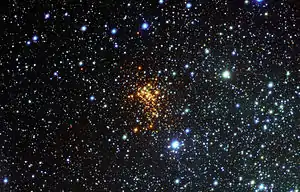
Westerlund 1-237 or Wd 1-237 is a possible red supergiant (RSG) in the constellation of Ara. It is one out of 4 known red supergiants in the Westerlund 1 super star cluster, although its outlying position, spectrum, and parallax, suggest it could be a foreground giant.[10] As a red supergiant, it would be one of the largest known stars and one of most luminous of its type.[7]
| Observation data Epoch J2000 Equinox J2000 | |
|---|---|
| Constellation | Ara |
| Right ascension | 16h 47m 03.1075s |
| Declination | −45° 52′ 18.9572″ |
| Apparent magnitude (V) | 19.008[1] |
| Characteristics | |
| Evolutionary stage | either a red supergiant or a foreground giant[2] |
| Spectral type | M3Ia[3] or M6+ III[4] |
| Apparent magnitude (B) | 22.8 |
| Apparent magnitude (J) | 5.075[5] |
| Apparent magnitude (H) | 3.01[5] |
| Apparent magnitude (K) | 2.18[5] |
| Apparent magnitude (G) | 11.259[6] |
| Apparent magnitude (R) | 13.634[1] |
| Astrometry | |
| Proper motion (μ) | RA: -3.09±0.15[6] mas/yr Dec.: -4.12±0.12[6] mas/yr |
| Parallax (π) | 0.3370 ± 0.1235 mas[6] |
| Distance | 3,000[7] or 623[8] pc |
| Absolute magnitude (MV) | –6.96[9] |
| Details | |
| if a supergiant | |
| Radius | 1,241±70[9] R☉ |
| Luminosity | 219,000±26,000[9] L☉ |
| Temperature | 3,550[9] - 3,605[8] K |
| Age | 7.9[9] Myr |
| if a foreground giant | |
| Radius | 216[8] R☉ |
| Luminosity | 1,000[2] or 7,178 – 7,379[8] L☉ |
| Temperature | 3,605[8] K |
| Other designations | |
Westerlund 1 W237, Westerlund 1 BKS B, 2MASS J16470309-4552189, Gaia EDR3 5940105904023386752 | |
| Database references | |
| SIMBAD | data |

Physical characteristics

Westerlund 1-237 is classified as a luminous cool supergiant emitting most of its energy in the infrared spectrum.[11] It is surrounded by a radio nebula which is similar in mass to those of Westerlund 1-20 and Westerlund 1-26, and moreover directly comparable to that of VY Canis Majoris. The elliptical structure of this nebula however indicates that it has been less affected by the cluster wind of Westerlund 1 (W20 and W26 have pronounced cometary shaped nebulae). The outflow velocity for the RSG wind is assumed to be around 30 km/s. The nebula itself seems to have a mass of 0.07 M☉ and a radius of about 0.11 parsecs. This results in a kinematic age around 3,600 years and a time averaged mass loss rate of 2×10⁻⁵ M☉ per year.[12]
The star occupies the upper right corner of the Hertzsprung-Russell diagram. With an effective temperature of 3,550 K and a bolometric luminosity of 219,000 L☉, the radius of Westerlund 1-237 would be 1,241 times the solar radius (R☉), making it larger than the orbit of Jupiter. The initial mass of W237 has been calculated from its position relative to theoretical stellar evolutionary tracks to be around 28 M☉ or 32 M☉ for a non-rotating star.[9]
Distance
The distance of Westerlund 1-237 is assumed to be around 8,500+2,000
−1,300 light years or 2,600+600
−400 parsecs[13] based on it being commonly thought of as a member of the Westerlund 1 star cluster (the elliptical shape of its nebula indicates that it might not be near the center of W1, while other RSGs like W20 and W26 are).[12] Another but older source suggests a similar distance of 3,000±500 parsecs.[7]
Westerlund's 1987 analysis assigned a spectral type of M6+ III to W1-237 and considered it to be a foreground giant with a luminosity only around 1,000 L☉.[2] Gaia Data Release 2 gives a parallax of 1.64±0.2608 mas for W1-237, implying a distance of 623+139
−96 pc and a luminosity of 7,178–7,379 L☉ with a corresponding radius of 216 R☉.[14][8] In 2020, the parallax was revised to the much smaller value of 0.3370±0.1235 mas.[6]
See also
References
- Bonanos, Alceste Z. (2007). "Variability of Young Massive Stars in the Galactic Super Star Cluster Westerlund 1". The Astronomical Journal. 133 (6): 2696–2708. arXiv:astro-ph/0702614. Bibcode:2007AJ....133.2696B. doi:10.1086/518093. S2CID 119074868.
- Westerlund, B. E. (1987). "Photometry and spectroscopy of stars in the region of a highly reddened cluster in ARA". Astronomy and Astrophysics. Supplement. 70 (3): 311–324. Bibcode:1987A&AS...70..311W. ISSN 0365-0138.
- Clark, J. S.; Ritchie, B. W.; Negueruela, I. (2010). "A serendipitous survey for variability amongst the massive stellar population of Westerlund 1". Astronomy and Astrophysics. 514: A87. arXiv:1003.5107. Bibcode:2010A&A...514A..87C. doi:10.1051/0004-6361/200913820. S2CID 14780809.
- Bonanos, Alceste Z. (2007). "Variability of Young Massive Stars in the Galactic Super Star Cluster Westerlund 1". The Astronomical Journal. 133 (6): 2696–2708. arXiv:astro-ph/0702614. Bibcode:2007AJ....133.2696B. doi:10.1086/518093. S2CID 119074868.
- Cutri, Roc M.; Skrutskie, Michael F.; Van Dyk, Schuyler D.; Beichman, Charles A.; Carpenter, John M.; Chester, Thomas; Cambresy, Laurent; Evans, Tracey E.; Fowler, John W.; Gizis, John E.; Howard, Elizabeth V.; Huchra, John P.; Jarrett, Thomas H.; Kopan, Eugene L.; Kirkpatrick, J. Davy; Light, Robert M.; Marsh, Kenneth A.; McCallon, Howard L.; Schneider, Stephen E.; Stiening, Rae; Sykes, Matthew J.; Weinberg, Martin D.; Wheaton, William A.; Wheelock, Sherry L.; Zacarias, N. (2003). "VizieR Online Data Catalog: 2MASS All-Sky Catalog of Point Sources (Cutri+ 2003)". CDS/ADC Collection of Electronic Catalogues. 2246: II/246. Bibcode:2003yCat.2246....0C.
- Brown, A. G. A.; et al. (Gaia collaboration) (2021). "Gaia Early Data Release 3: Summary of the contents and survey properties". Astronomy & Astrophysics. 649: A1. arXiv:2012.01533. Bibcode:2021A&A...649A...1G. doi:10.1051/0004-6361/202039657. S2CID 227254300. Gaia EDR3 record for this source at VizieR.
- Fok, Thomas K. T.; Nakashima, Jun-Ichi; Yung, Bosco H. K.; Hsia, Chih-Hao; Deguchi, Shuji (2012). "Maser Observations of Westerlund 1 and Comprehensive Considerations on Maser Properties of Red Supergiants Associated with Massive Clusters". The Astrophysical Journal. 760 (1): 65. arXiv:1209.6427. Bibcode:2012ApJ...760...65F. doi:10.1088/0004-637X/760/1/65. S2CID 53393926.
- Messineo, M.; Brown, A. G. A. (2019). "A Catalog of Known Galactic K-M Stars of Class I Candidate Red Supergiants in Gaia DR2". The Astronomical Journal. 158 (1): 20. arXiv:1905.03744. Bibcode:2019AJ....158...20M. doi:10.3847/1538-3881/ab1cbd. S2CID 148571616.
- Arévalo, Aura (2019). The Red Supergiants in the Supermassive Stellar Cluster Westerlund 1 (Thesis). doi:10.11606/D.14.2019.tde-12092018-161841.
- "APOD: 2017 June 20 - The Massive Stars in Westerlund 1". apod.nasa.gov. Retrieved 2020-06-21.
- "Cl* Westerlund 1 W 237". Simbad.
- Dougherty, S. M.; Clark, J. S.; Negueruela, I.; Johnson, T.; Chapman, J. M. (2010-02-01). "Radio emission from the massive stars in the galactic super star cluster Westerlund 1". Astronomy & Astrophysics. 511: A58. arXiv:0912.4165. Bibcode:2010A&A...511A..58D. doi:10.1051/0004-6361/200913505. ISSN 0004-6361. S2CID 9792700.
- Aghakhanloo, Mojgan; Murphy, Jeremiah W.; Smith, Nathan; Parejko, John; Díaz-Rodríguez, Mariangelly; Drout, Maria R.; Groh, Jose H.; Guzman, Joseph; Stassun, Keivan G. (2020-02-21). "Inferring the parallax of Westerlund 1 from Gaia DR2". Monthly Notices of the Royal Astronomical Society. 492 (2): 2497–2509. arXiv:1901.06582. Bibcode:2020MNRAS.492.2497A. doi:10.1093/mnras/stz3628. ISSN 0035-8711. S2CID 119465620.
- Bailer-Jones, C. A. L.; Rybizki, J.; Fouesneau, M.; Mantelet, G.; Andrae, R. (2018). "Estimating Distance from Parallaxes. IV. Distances to 1.33 Billion Stars in Gaia Data Release 2". The Astronomical Journal. 156 (2): 58. arXiv:1804.10121. Bibcode:2018AJ....156...58B. doi:10.3847/1538-3881/aacb21. S2CID 119289017.
