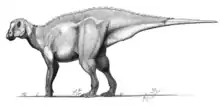
Trinisaura
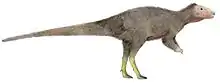
Trinisaura is an extinct genus of ornithopod dinosaur known from the lower levels of the Late Cretaceous Snow Hill Island Formation (Campanian stage) of James Ross Island, Antarctica. It contains a single species, Trinisaura santamartaensis.[1]
| Trinisaura Temporal range: Campanian ~ | |
|---|---|
 | |
Scientific classification  | |
| Kingdom: | Animalia |
| Phylum: | Chordata |
| Clade: | Dinosauria |
| Order: | †Ornithischia |
| Clade: | †Elasmaria |
| Genus: | †Trinisaura Coria et al. 2013 |
| Type species | |
| †Trinisaura santamartaensis Coria et al. 2013 | |
Discovery and naming
The species was in 2013 named by Rodolfo Aníbal Coria e.a. The generic name honours the geologist Trinidad Diaz. The specific name refers to the Santa Marta Cove site where the specimen was in 2008 found by Coria and Juan José Moly.[1] That same year, the find was reported in the scientific literature.[2]
The holotype, MLP-III-1-1, consists of a partial skeleton lacking the skull, of a subadult individual about 1.5 metres (4.9 ft) in length.[1]
Phylogeny
The cladogram below follows Coria et al., 2013 phylogenetic analysis. Trinisaura is found to be an ornithopod, however the inclusion of Thescelosaurus neglectus is necessary to determine whether it is a basal iguanodont.[1]
| Ornithopoda |
| ||||||||||||||||||||||||||||||||||||||||||
In 2015, it along with several other Patagonian and Antarctic ornithopods was found to be a part of the basal group of iguanodonts, Elasmaria.
Cladogram based in the phylogenetic analysis of Rozadilla et al., 2015:
| |||||||||||||||||||||||||||||||||||||||||||||||||||||||||||||||||||
Description
Trinisaura lived approximately 83 to 72 million years ago during the Late Cretaceous period. It was likely bipedal, and relied on speed and agility to avoid predators.[1]
References
- Coria, R. A.; Moly, J. J.; Reguero, M.; Santillana, S.; Marenssi, S. (2013). "A new ornithopod (Dinosauria; Ornithischia) from Antarctica". Cretaceous Research. 41: 186–193. doi:10.1016/j.cretres.2012.12.004.
- Coria, R.A., Moly, J.J., Reguero, M., Santillana, S., 2008, "Nuevos restos de Ornithopoda (Dinosauria, Ornithischia) de la Fm. Santa Marta, Isla J. Ross, Antártida", Ameghiniana 45(4), Supl., 25R
| |||||||||||||||||||||||||||||||||||||||||||||||||
| |||||||||||||||||||||||||||||||||||||||||||||||||
| |||||||||||||||||||||||||||||||||||||||||||||||||
| |||||||||||||||||||||||||||||||||||||||||||||||||
.jpg.webp)