Tactopoda
Tactopoda is a proposed clade of protostome animals that includes the phyla Tardigrada and Euarthropoda, supported by various morphological observations.[1][2] The cladogram below shows the relationships implied by this hypothesis.
| Panarthropoda |
| |||||||||||||||
| Tactopoda Temporal range: | |
|---|---|
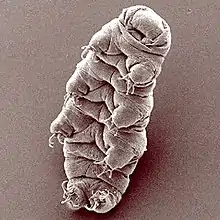 | |
| The tardigrade Hypsibius dujardini | |
 | |
| The blue crab Callinectes sapidus, an arthropod | |
Scientific classification  | |
| Kingdom: | Animalia |
| Subkingdom: | Eumetazoa |
| Clade: | ParaHoxozoa |
| Clade: | Bilateria |
| Clade: | Nephrozoa |
| (unranked): | Protostomia |
| Superphylum: | Ecdysozoa |
| (unranked): | Panarthropoda |
| (unranked): | Tactopoda Budd, 2001 [1] |
The competing hypothesis is that Arthropoda sensu lato[3] (= Euarthropoda + Onychophora, the arthropods and the velvet worms) is monophyletic,[4] and tardigrades lie outside this grouping.
| Panarthropoda |
| |||||||||||||||
Anatomic arguments for the tactopoda monophyly include similarities in the anatomies of head, legs, and muscles between the arthropods and the tardigrades. Anatomic arguments against it include that tardigrades lack the kind of circulatory system (including a dorsal heart) which the arthropods and the velvet worms share. Graham Budd argued that the lack of this system in recent tardigrades is due to their miniature size, which makes a complex circulatory system superfluous; thus, the loss of this feature would be a secondary property, acquired as the tardigrade stem group turned smaller, and both the Euarthropoda+Onychophora circulatory system and a relatively large size should be a feature of the last common ancestor of all three groups.[1] However, Gregory Edgecombe also invoked phylogenomic evidence in favour of the alternative Euarthropoda+Onychophora grouping.[4]
Proposed classification
- Phylum Tardigrada
- Class Eutardigrada
- Class Heterotardigrada
- Class Mesotardigrada
- Phylum Arthropoda
- Class Pycnogonida (?)
- Clade Arachnomorpha
- Class †Trilobita
- Order †Aglaspida
- Order †Strabopida
- Class Pycnogonida (?)
- Order †Cheloniellida
- Subphylum Chelicerata
- Class Xiphosura
- Class †Eurypterida
- Class †Chasmataspidida
- Class Pycnogonida (?)
- Class Arachnida
- Clade Mandibulata
- Order †Euthycarcinoidea
- Subphylum Myriapoda
- Clade Pancrustacea
- Clade Oligostraca
- Class Ostracoda
- Class Ichthyostraca
- Clade Altocrustacea
- Clade Multicrustacea
- Class Hexanauplia
- Class Malacostraca
- Class Thecostraca
- Clade Allotriocarida
- Class Branchiopoda
- Clade Miracrustacea
- Superclass Xenocarida
- Class Cephalocarida
- Class Remipedia
- Subphylum Hexapoda
- Paraphyletic class Entognatha
- Clade Ectognatha
- Class Insecta
- Superclass Xenocarida
- Clade Multicrustacea
- Clade Oligostraca
Phylogeny
| Panarthropoda |
| ||||||||||||||||||||||||||||||||||||||||||||||||||||||||||||||||||||||||||||||||||||||||||||||||||||||||||||||||||||||||||||||||||||||||||||||||
References
- Graham E. Budd (2001). "Tardigrades as 'stem-group arthropods': the evidence from the Cambrian fauna" (PDF). Zoologischer Anzeiger. 240 (3–4): 265–279. doi:10.1078/0044-5231-00034. Archived from the original (PDF) on 2016-03-03.
- Smith, M. R.; Ortega-Hernández, J. (2014). "Hallucigenia's onychophoran-like claws and the case for Tactopoda". Nature. 514 (7522): 363–366. doi:10.1038/nature13576. PMID 25132546. S2CID 205239797.
- J. Ortega-Hernández, "Making sense of 'lower' and 'upper' stem-group Euarthropoda, with comments on the strict use of the name Arthropoda von Siebold, 1848," Biol. Rev., vol. 91, no. 1, pp. 255–273, 2016.
- Gregory D. Edgecombe (2010). "Arthropod phylogeny: An overview from the perspectives of morphology, molecular data and the fossil record". Arthropod Structure & Development. 39 (2–3): 74–87. doi:10.1016/j.asd.2009.10.002. PMID 19854297.