Seoul Subway Line 3
Seoul Metropolitan Subway Line 3 (dubbed The Orange Line) of the Seoul Metropolitan Subway is a rapid transit service that connects Eunpyeong District to Gangnam and southeastern Seoul. Most trains head further northwest to serve Goyang via the Ilsan Line.[1] In 2019, the Seoul Metro operated section had an annual ridership of 330 million or about 900,000 passengers per day.[2]
| Line 3 | |
|---|---|
  | |
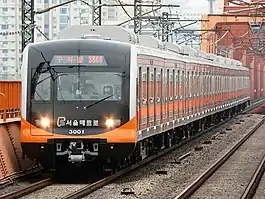 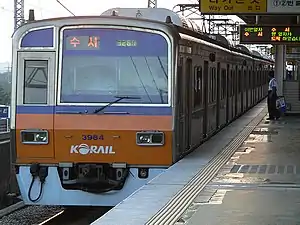 Seoul Metro 3000 series EMU in April 2009 (up) Korail Class 3000 EMU in September 2008 (down) | |
| Overview | |
| Native name | 3호선(三號線) Sam Hoseon |
| Status | Operational |
| Termini | Jichuk Ogeum |
| Stations | 34 |
| Service | |
| Type | Rapid transit / Commuter Rail |
| System | Seoul Metropolitan Subway |
| Operator(s) | Seoul Metro & Korail |
| History | |
| Opened | July 12, 1985 |
| Technical | |
| Line length | 57.4 km (35.7 mi) |
| Number of tracks | 2 |
| Electrification | 1,500 V DC overhead catenary |
| Operating speed | 80 km/h (50 mph) |
In December 2010 the line is recorded as having the second highest WiFi data consumption in the Seoul Metropolitan area. It averaged 1.8 times more than the other 14 subway lines fitted with WiFi service zones.[3]
History
Construction began in 1980, and the first section of Line 3 opened (Gupabal–Yangjae; Jichuk opened in 1990) after the completion of work in two stages during 1985, along with subway Line 4. In October 1993, a second extension to the south was opened (Yangjae–Suseo).
In March 1996, the Korail Ilsan Line opened and allowed Line 3 trains to through operate all the way to the city of Goyang. There are 2 depots near Jichuk station and Suseo station, which are for both Korail and Seoul Metro.
A 3 km extension opened on February 18, 2010, stretching from Suseo to Garak Market (Line 8) and Ogeum (Line 5).
On December 27, 2014, Wonheung station opened between Wondang and Samsong stations.
Tourism
In January 2013, the Seoul Metropolitan Rapid Transit Corporation, published free guidebooks in three languages: English, Japanese and Chinese (simplified and traditional), which features eight tours as well as recommendations for accommodations, restaurants and shopping centers. The tours are designed with different themes for travel along the subway lines, e.g. Korean traditional culture. Which goes from Jongno 3-ga station to Anguk station and Gyeongbokgung station on this line that showcases antique shops and art galleries of Insa-dong.[4]
Stations
| Station Number |
Station Name English |
Station Name Hangul |
Station Name Hanja |
Transfer | Line Name | Distance in km |
Total Distance |
Location | |
|---|---|---|---|---|---|---|---|---|---|
309 |
Daehwa | 대화 | 大化 | --- |
0.0 |
||||
310 |
Juyeop | 주엽 | 注葉 | 1.4 |
1.4 | ||||
311 |
Jeongbalsan | 정발산 | 鼎鉢山 | 1.6 |
3.0 | ||||
312 |
Madu | 마두 | 馬頭 | 0.9 |
3.9 | ||||
313 |
Baekseok (Ilsan Hospital) |
백석 | 白石 | 1.4 |
5.3 | ||||
314 |
Daegok | 대곡 | 大谷 |  |
2.5 |
7.8 | |||
315 |
Hwajeong | 화정 | 花井 | 2.1 |
9.9 | ||||
316 |
Wondang | 원당 | 元堂 | 2.6 |
12.5 | ||||
317 |
Wonheung | 원흥 | 元興 | 2.9 |
15.4 | ||||
318 |
Samsong | 삼송 | 三松 | 2.1 |
17.5 | ||||
319 |
Jichuk | 지축 | 紙杻 | 1.7 |
19.2 | ||||
320 |
Gupabal | 구파발 | 舊把撥 | Seoul Metro Line 3 |
1.5 |
20.7 |
|||
321 |
Yeonsinnae | 연신내 | 연신내 |  |
2.0 |
22.7 | |||
322 |
Bulgwang | 불광 | 佛光 | |
1.3 |
24.0 | |||
323 |
Nokbeon | 녹번 | 碌磻 | 1.1 |
25.1 | ||||
324 |
Hongje (Seoul Culture Arts Univ.) |
홍제 | 弘濟 | 1.6 |
26.7 |
||||
325 |
Muakjae | 무악재 | 毋岳재 | 0.9 |
27.6 | ||||
326 |
Dongnimmun | 독립문 | 獨立門 | 1.1 |
28.7 | ||||
327 |
Gyeongbokgung (Government Complex-Seoul) |
경복궁 | 景福宮 | 1.6 |
30.3 |
||||
328 |
Anguk | 안국 | 安國 | 1.1 |
31.4 | ||||
329 |
Jongno 3(sam)-ga | 종로3가 | 鍾路3街 |   |
1.0 |
32.4 | |||
330 |
Euljiro 3(sam)-ga | 을지로3가 | 乙支路3街 |  |
0.6 |
33.0 |
|||
331 |
Chungmuro | 충무로 | 忠武路 |  |
0.7 |
33.7 | |||
332 |
Dongguk University | 동대입구 | 東大入口 | 0.9 |
34.6 | ||||
333 |
Yaksu | 약수 | 藥水 | |
0.7 |
35.3 | |||
334 |
Geumho | 금호 | 金湖 | 0.8 |
36.1 |
||||
335 |
Oksu | 옥수 | 玉水 | |
0.8 |
36.9 | |||
336 |
Apgujeong (Hyundai Department Store) |
압구정 | 狎鷗亭 | 2.1 |
39.0 |
||||
337 |
Sinsa | 신사 | 新沙 |  (2022) (2022) |
1.5 |
40.5 | |||
338 |
Jamwon | 잠원 | 蠶院 | 0.9 |
41.4 |
||||
339 |
Express Bus Terminal | 고속터미널 | 高速터미널 |   |
1.2 |
42.6 | |||
340 |
Seoul Nat'l Univ. of Education (Court & Prosecutor's Office) |
교대 | 敎大 | |
1.6 |
44.2 | |||
341 |
Nambu Bus Terminal (Seoul Arts Center) |
남부터미널 | 南部터미널 | 0.9 |
45.1 | ||||
342 |
Yangjae (Seocho-gu Office) |
양재 | 良才 | |
1.8 |
46.9 | |||
343 |
Maebong | 매봉 | 매봉 | 1.2 |
48.1 |
||||
344 |
Dogok | 도곡 | 道谷 |  |
0.8 |
48.9 | |||
345 |
Daechi | 대치 | 大峙 | 0.8 |
49.7 | ||||
346 |
Hangnyeoul | 학여울 | 학여울 | 0.8 |
50.5 | ||||
347 |
Daecheong | 대청 | 대청 | 0.9 |
51.4 | ||||
348 |
Irwon | 일원 | 逸院 | 1.2 |
52.6 | ||||
349 |
Suseo | 수서 | 水西 |  |
1.8 |
54.4 | |||
350 |
Garak Market | 가락시장 | 可樂市場 |  |
1.2 |
55.6 |
|||
351 |
National Police Hospital | 경찰병원 | 警察病院 | 0.8 |
56.4 | ||||
352 |
Ogeum | 오금 | 梧琴 | |
0.6 |
57.0 | |||
Rolling stock
Current
- Seoul Metro 3000 series
- Korail Class 3000
- First generation – since 1995
- Second generation – since 2022
- Not yet in service.
_arriving_at_Oksu.jpg.webp) Seoul Metro 3000 series Chopper-controled EMU
Seoul Metro 3000 series Chopper-controled EMU_leaving_Oksu.jpg.webp) Seoul Metro 3000 series Chopper-controled EMU (rebuilt cars)
Seoul Metro 3000 series Chopper-controled EMU (rebuilt cars)- Seoul Metro 3000 series VVVF inverter-controlled (First generation)
- Korail Class 3000 (First generation)
References
- "서울교통공사 블로그 : 네이버 블로그". blog.naver.com. Retrieved May 31, 2021.
- "서울시 지하철수송 통계". data.seoul.go.kr (in Korean). Retrieved May 21, 2021.
- "Seoul Subway Line No. 2 Becomes Major WiFi Hotspot". Chosun Ilbo. December 24, 2010. Retrieved April 25, 2012.
- Kwon, Sang-soo (January 26, 2013). "Free guide for Seoul's subway riders". Joongang Daily. Archived from the original on April 12, 2013. Retrieved January 27, 2013.
External links
 |
Wikimedia Commons has media related to Seoul Subway Line 3. |
- Seoul Metropolitan Government's Line 3 extension page (in Korean) includes a route map and status information for the extension from Suseo to Garak Market.
- UrbanRail.Net's Seoul Subway Page
- Map, station and route finder
Korail lines | ||||||||||||||||
|---|---|---|---|---|---|---|---|---|---|---|---|---|---|---|---|---|
| Current/Active |
|  | ||||||||||||||
| Future |
| |||||||||||||||
| Railways |
| ||||||||||||||||
|---|---|---|---|---|---|---|---|---|---|---|---|---|---|---|---|---|---|
| Roads |
| ||||||||||||||||
| Buses |
| ||||||||||||||||
| Airports | |||||||||||||||||
| Related topics |
| ||||||||||||||||

| Seoul Capital Area |
| ||||||||||||||||
|---|---|---|---|---|---|---|---|---|---|---|---|---|---|---|---|---|---|
| Busan |
| ||||||||||||||||
| Daegu |
| ||||||||||||||||
| Gwangju | |||||||||||||||||
| Daejeon | |||||||||||||||||
Tilt Letter : Under construction | |||||||||||||||||