Riojasuchus
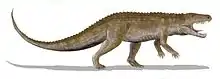
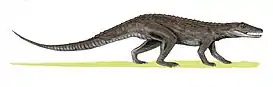
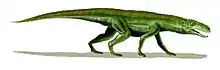
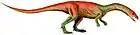
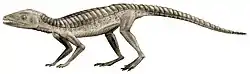
Riojasuchus is an extinct genus of Late Triassic (Norian) quadrupedal archosaur. Riojasuchus is a member of Ornithosuchidae, a family of facultatively bipedal carnivores that were geographically widespread during the Late Triassic. Two other genera, Ornithosuchus and Venaticosuchus, are currently known. The holotype specimen is PVL 3827. It was found in the Los Colorados Formation of the Ischigualasto-Villa Unión Basin in northwestern Argentina.
| Riojasuchus Temporal range: Norian ~ | |
|---|---|
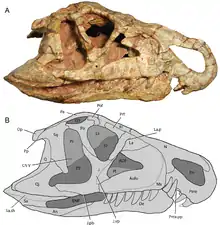 | |
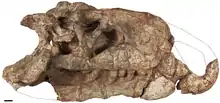
| Holotype skull and diagram | |
Scientific classification  | |
| Kingdom: | Animalia |
| Phylum: | Chordata |
| Class: | Reptilia |
| Clade: | Pseudosuchia |
| Family: | †Ornithosuchidae |
| Genus: | †Riojasuchus Bonaparte 1969 |
| Type species | |
| Riojasuchus tenuisceps Bonaparte 1969 | |
Discovery and naming
The holotype specimen is PVL 3827, consisting of a mostly complete crania and a partial postcrania. A majority of the postcranial material was preserved. The skeleton was found with others in the upper section of the Los Colorados Formation. Other than the holotype, it is known from three skeletons.[1]
Description
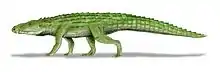
The skull of the type specimen is 25 centimetres (9.8 in) long, and has a large, curved snout and short mandibles.
Distinguishing characteristics
Many characteristics were identified by Bonaparte in 1969. They are listed below:[1]
- a preorbital vacuity well bordered by protruding edges of the smaller preorbital opening, found in Ornithosuchus;
- an outgoing lateral lacrimal edge;
- an infratemporal fenestra present in the shortest adult skull with mandibular fenestra;
- the top of the surangular laterally pointed, and with a small prearticular process;
- short atlas and cervical vertebrae, all with a ventral keel;
- an ilium, pubis and femur, with the talus and calcaneus of the type of Ornithosuchus
- and median orbits with a higher bottom than in Ornithosuchus.
Classification
Riojasuchus is a member of Ornithosuchidae, a family of facultatively bipedal carnivores that were geographically widespread during the Late Triassic.[1] Two other genera, Ornithosuchus and Venaticosuchus, are currently known. The group was originally considered to be related to dinosaurs, before many phylogenetical analysises.[2]
Below is a phylogenetic cladogram by Butler et al. in 2011 showing the cladistics of Archosauriformes, focusing mostly on Pseudosuchia:[3] Clade names follow Nesbitt 2011.[4]
| ||||||||||||||||||||||||||||||||||||||||||||||||||||||||||||||||||||||||||||||||||||||||||||||||||||||||||||||||||||||||||||||||||||||||||||||||||||||||||||||||||||||||||||||||||||||||||||||||||||||||||||||||||||||||||||||||||||||||||||||||||||
Paleoecology

Fossils of Riojasuchas are found in the Los Colorados Formation, a Late Triassic unit in Argentina,[1] and date to approximately 217 to 215 million years ago.[2] At that age, it is the youngest ornithosuchid known.[2] It lived alongside the protosuchid Hemiprotosuchus; the sphenosuchid Pseudohesperosuchus; the stagonolepidid Neoaetosauroides; the melanorosaurid Strenusaurus; and the riojasaurid Riojasaurus.[1]
References
- Bonaparte, J. F. (1969). "Dos Nuevas 'faunas' de reptiles triásicos de Argentina" (PDF). First Gondwana Symposium (in Spanish). 2: 283–306.
- von Baczko, M. B.; Ezcurra, M. D. (2013). "Ornithosuchidae: a group of Triassic Archosaurs with a unique ankle joint". In Nesbitt, S. J.; Desojo, J. B.; Irmis, R. B. (eds.). Anatomy, Phylogeny and Palaeobiology of Early Archosaurs and Their Kin. The Geological Society. pp. 183–195. ISBN 978-1-86239-361-5.
- Butler, R. J.; Brusatte, S. J.; Reich, M.; Nesbitt, S. J.; Schoch, R. R.; Hornung, J. J. (2011). Farke, Andrew A. (ed.). "The Sail-Backed Reptile Ctenosauriscus from the Latest Early Triassic of Germany and the Timing and Biogeography of the Early Archosaur Radiation". PLOS ONE. 6 (10): e25693. Bibcode:2011PLoSO...625693B. doi:10.1371/journal.pone.0025693. PMC 3194824. PMID 22022431.
- Nesbitt, S. J. (2011). "The Early Evolution of Archosaurs: Relationships and the Origin of Major Clades". Bulletin of the American Museum of Natural History. 352: 189. doi:10.1206/352.1. hdl:2246/6112. ISSN 0003-0090. S2CID 83493714.
| |||||||||||||||||||||||||||||||||||||||||||||
| |||||||||||||||||||||||||||||||||||||||||||||
| |||||||||||||||||||||||||||||||||||||||||||||
| |||||||||||||||||||||||||||||||||||||||||||||
| |||||||||||||||||||||||||||||||||||||||||||||