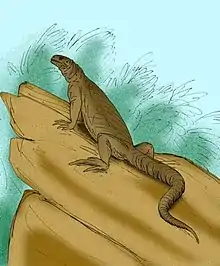
Monstersauria
Monstersauria is a clade of varanoid lizards, defined as all taxa more closely related to Heloderma than Varanus. It includes Heloderma, as well as several extinct genera, such as Estesia, Primaderma and Gobiderma, but it was found to be polyphyletic in the most recent and complete squamate phylogenetic analysis by Reeder et al. (2015).[3]
| Monstersauria Temporal range: [1] | |
|---|---|
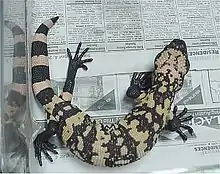 | |
| Gila monster, Heloderma suspectum | |
Scientific classification  | |
| Kingdom: | Animalia |
| Phylum: | Chordata |
| Class: | Reptilia |
| Order: | Squamata |
| Infraorder: | Neoanguimorpha |
| Clade: | Monstersauria Norell and Gao, 1997[2] |
| Subgroups | |
| |
Classification
Traditionally, Monstersauria was thought to include the modern Helodermatidae along with fossil genera such as Gobiderma and Estesia on the finding that it was a sister to Varanidae. But in more recent years, such as 2004 and 2008, more precise molecular studies have shown that the extant Heloderma is closer to Anguidae & kin than to Varanoidea. A large-scale integrated analysis on squamate phylogeny incorporating 737 characters of morphological and molecular data in 2015 analyzed the traditionally-monstersaurian fossil taxa along with the rest of the dataset, and what it found was a well-supported separation of the extinct monstersaurians from the extant Heloderma. In total, three different possibilities exist: either Heloderma is sister to the rest of Neoanguimorpha and fossil monstersaurians nest within Varanoidea (based on molecular and combined; optimal arrangement); they both nest with each other in Neoanguimorpha (unlikely possibility based on parsimony analysis of combined data), or they both nest with each other in Varanoidea (based on morphology only). The most likely tree chosen by the authors, based on the combined dataset of 691 morphological characters and 46 molecular characters across 210 operational taxonomic units, is as shown, focusing on Anguimorpha:[4]
| Squamata |
| ||||||||||||||||||||||||||||||||||||||||||||||||||||||||||||||||||||||||||||||||||||||||||||||||||||||||||||||||||||||||||||||||||||
References
- Tadahiro Ikeda, Hidetoshi Ota, Tomonori Tanaka, Kenji Ikuno, Katsuhiro Kubota, Kohei Tanaka and Haruo Saegusa. 2022. A Fossil Monstersauria (Squamata: Anguimorpha) from the Lower Cretaceous Ohyamashimo Formation of the Sasayama Group in Tamba City, Hyogo Prefecture, Japan. Cretaceous Research. 130, 105063. DOI: 10.1016/j.cretres.2021.105063
- M. A. Norell and K. Gao. (1997). Braincase and phylogenetic relationships of Estesia mongoliensis from the Late Cretaceous of the Gobi Desert and the recognition of a new clade of lizards. American Museum Novitates 3211:1-25
- Tod W. Reeder; Ted M. Townsend; Daniel G. Mulcahy; Brice P. Noonan; Perry L. Wood, Jr.; Jack W. Sites, Jr.; John J. Wiens (2015). "Integrated Analyses Resolve Conflicts over Squamate Reptile Phylogeny and Reveal Unexpected Placements for Fossil Taxa". PLOS ONE. 10 (3): e0118199. Bibcode:2015PLoSO..1018199R. doi:10.1371/journal.pone.0118199. PMC 4372529. PMID 25803280.
- Tod W. Reeder; Ted M. Townsend; Daniel G. Mulcahy; Brice P. Noonan; Perry L. Wood, Jr.; Jack W. Sites, Jr.; John J. Wiens (2015). "Integrated Analyses Resolve Conflicts over Squamate Reptile Phylogeny and Reveal Unexpected Placements for Fossil Taxa://S8 Fig Estimated phylogeny of squamates based on likelihood analysis of the combined morphological and molecular data, including all taxa (-lnL = 979677.56)". PLOS ONE. 10 (3): e0118199. Bibcode:2015PLoSO..1018199R. doi:10.1371/journal.pone.0118199. PMC 4372529. PMID 25803280.
Extinct squamate genera | |||||||||||||||||||||||||||||||||||||||||||||||||
|---|---|---|---|---|---|---|---|---|---|---|---|---|---|---|---|---|---|---|---|---|---|---|---|---|---|---|---|---|---|---|---|---|---|---|---|---|---|---|---|---|---|---|---|---|---|---|---|---|---|
| |||||||||||||||||||||||||||||||||||||||||||||||||
| |||||||||||||||||||||||||||||||||||||||||||||||||
| |||||||||||||||||||||||||||||||||||||||||||||||||
| |||||||||||||||||||||||||||||||||||||||||||||||||
| |||||||||||||||||||||||||||||||||||||||||||||||||
| |||||||||||||||||||||||||||||||||||||||||||||||||
| |||||||||||||||||||||||||||||||||||||||||||||||||
| |||||||||||||||||||||||||||||||||||||||||||||||||