Melolonthinae
Melolonthinae is a subfamily of the scarab beetles (family Scarabaeidae). It is a very diverse group; distributed over most of the world, it contains over 11,000 species in over 750 genera.[1] Some authors include the scarab subfamilies Euchirinae and Pachypodinae as tribes in the Melolonthinae.
| Melolonthinae | |
|---|---|
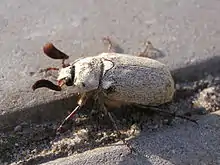 | |
| Male Polyphylla alba (Melolonthini) | |
Scientific classification  | |
| Kingdom: | Animalia |
| Phylum: | Arthropoda |
| Class: | Insecta |
| Order: | Coleoptera |
| Family: | Scarabaeidae |
| Subfamily: | Melolonthinae Leach, 1819 |
| Diversity | |
| About 20–30 tribes | |
| Synonyms | |
|
Hopliinae | |
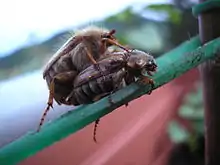
Unlike some of their relatives, their habitus is usually not bizarre. They resemble the Rutelinae in being fairly plesiomorphic in outward appearance. Like in many Scarabaeidae, males have large fingered antennae, while those of the females are smaller and somewhat knobby. In the Melolonthinae, this sexual dimorphism is particularly pronounced. Many species have striking – though rarely brilliant or iridescent – hues and bold patterns of hairs.
Being often quite sizeable and swarming in numbers at certain times, for example the Amphimallon, Phyllophaga and Polyphylla "june beetles" or the Melolontha cockchafers – all from tribe Melolonthini – feature widely in folklore. Some Melolonthinae are economically significant pests. Other than the Melolonthini, the most diverse tribes are the Ablaberini, Liparetrini, Macrodactylini, Tanyproctini and Sericini.
Systematics
.jpg.webp)
According to various authors, the living Melolonthinae are divided into about 20-30 tribes. Some notable genera and species are also listed here:
- Ablaberini Burmeister, 1855 – including Camentini
- Automoliini Britton, 1978
- Chasmatopterini Lacordaire, 1856
- Colymbomorphini Blanchard, 1850 – including Stethaspini and Xylonychini
- Comophorinini Britton, 1957 – including Comophini
- Dichelonychini Burmeister 1855
- Diphucephalini Britton, 1957
- Diphycerini Medvedev, 1952 – sometimes in Macrodactylini
- Diplotaxini Kirby, 1837 – sometimes in Melolonthini
- Heteronychini Britton, 1957
- Heteronyx Guérin-Méneville, 1838
- Hopliini Latreille, 1829
- Lichniini Burmeister, 1844
- Liparetrini Burmeister, 1855 – including Allarini, Colpochilini
- Macrodactylini Kirby, 1837 – including Dichelonyciini
- Maechidiini Burmeister, 1855
- Melolonthini Leach, 1819 – including Rhizotrogini
- Amphimallon
- Brahmina
- Holotrichia
- Leucopholis
- Melolontha – cockchafers, May bugs
- Phyllophaga – May beetles
- Polyphylla
- Rhizotrogus
- Oncerini LeConte, 1861
- Pachytrichini Burmeister, 1855
- Phyllotocidiini Britton, 1957
- Podolasiini Howden, 1997 – sometimes in Hopliini
- Scitalini Britton, 1957
- Sericini Dalla Torre, 1912
- Sericoidini Burmeister, 1855
- Systellopini Sharp, 1877
- Tanyproctini Erichson, 1847 – includes Pachydemini
In addition, a prehistoric tribe, the Cretomelolonthini, is only known from fossils.
Several genera are of unclear relations; they are not yet firmly placed in a tribe:
- Acoma
- Conebius Fuavel, 1903
- Costelytra – Liparetrini?
- Hemictenius – Pachydemini?
- Metascelis Westwood, 1842
- Mycernus – Colymbomorphini?
- Odontria – Liparetrini?
- Prodontria – Liparetrini?
- Psilodontria – Colymbomorphini?
- Scythrodes – Liparetrini?
- Sericospilus – Liparetrini?
- Xenaclopus[2]
"Anonetus" and "Tryssus", both used by Erichson in 1847, are nomina nuda. Holophylla and Hoplorida are of uncertain validity.
References
- Cave, R.D. & Ratcliffe, B.C. (2008). Scarab beetles (Coleoptera: Scarabaeoidea). In J.F. Capinera (Ed.), Encyclopedia of Entomology (pp. 3273–3286. Heidelberg. Springer.
- Ocampo, F.C., Vaz-de-Mello, F.Z. (2008) The genus Xenaclopus Arrow (Coleoptera: Scarabaeidae): redescription and removal from the Aclopinae, with systematic notes. Zootaxa, 1916: 57–62.
 Data related to Melolonthinae at Wikispecies
 Media related to Melolonthinae at Wikimedia Commons