List of culinary knife cuts
There are a number of regular knife cuts that are used in many recipes, each producing a standardized cut piece of food. The two basic shapes are the strip and the cube.[1]
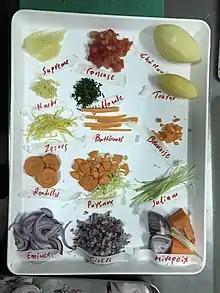
Numerous knife cuts with their corresponding French name
Strip cuts
- Pont-neuf; used for fried potatoes ("thick cut" or "steak cut" chips), pont-neuf measures from 1⁄3 by 1⁄3 by 2+1⁄2–3 inches (1 cm × 1 cm × 6 cm–8 cm) to 3⁄4 by 3⁄4 by 3 inches (2 cm × 2 cm × 8 cm)[2][3]
- Batonnet; French for "little stick", the batonnet measures approximately 1⁄4 by 1⁄4 by 2–2+1⁄2 inches (0.6 cm × 0.6 cm × 5 cm–6 cm). It is also the starting point for the small dice.[1]
- Julienne; referred to as the allumette (or matchstick) when used on potatoes, the julienne measures approximately 1⁄8 by 1⁄8 by 1–2 inches (0.3 cm × 0.3 cm × 3 cm–5 cm). It is also the starting point for the brunoise cut.[1] The first reference to Julienne occurs in François Massialot's Le Cuisinier Royal in 1722.[1]
- Fine julienne; measures approximately 1⁄16 by 1⁄16 by 1–2 inches (0.2 cm × 0.2 cm × 3 cm–5 cm), and is the starting point for the fine brunoise cut.[1]
- Chiffonade; rolling leafy greens and slicing the roll in sections from 4-10mm in width
Cube cuts
Cuts with six even sides include:[1]
- Large dice; (or "Carré" meaning "square" in French); sides measuring approximately 3⁄4 inch (20 mm)
- Medium dice; (Parmentier); sides measuring approximately 1⁄2 inch (13 mm)
- Small dice; (Macédoine); sides measuring approximately 1⁄4 inch (5 mm)
- Brunoise; sides measuring approximately 1⁄8 inch (3 mm)
- Fine brunoise; sides measuring approximately 1⁄16 inch (2 mm)
Other cuts
Other cuts include:[1]
- Paysanne; 1⁄2 by 1⁄2 by 1⁄8 inch (10 mm × 10 mm × 3 mm)
- Lozenge; diamond shape, 1⁄2 by 1⁄2 by 1⁄8 inch (10 mm × 10 mm × 3 mm)
- Fermière; cut lengthwise and then sliced to desired thickness 1⁄8–1⁄2 inch (3–10 mm)
- Rondelle; cylindrical vegetatables cut to discs of desired thickness 1⁄8–1⁄2 inch (3–10 mm)
- Tourné; 2 inches (50 mm) long with seven faces usually with a bulge in the center portion
- Mirepoix; 3⁄16–1⁄4 inch (5–7 mm)
- Rough Cut; chopped more or less randomly resulting in a variety of sizes and shapes
- Mincing; very finely divided into uniform pieces[4]
- Wedges; round vegetables cut equally radially, used on tomato, potato, lemon, cut into four or six pieces or more
References
- The Culinary Institute of America (2011). The Professional Chef (9th ed.). Hoboken, New Jersey: John Wiley & Sons. pp. 622–4. ISBN 978-0-470-42135-2. OCLC 707248142.
- "Pont Neuf Potatoes". Cooks Info. Retrieved 8 November 2018.
- "Knife Cut Images". The Food School. Retrieved 8 November 2018.
- "14 basic cuts of vegetables with sizes". Food and Beverage service knowledge. Retrieved 2021-08-29.
This article is issued from Wikipedia. The text is licensed under Creative Commons - Attribution - Sharealike. Additional terms may apply for the media files.