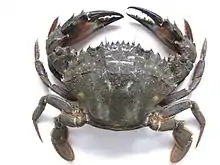
Heterotremata
Heterotremata is a clade of crabs, comprising those crabs in which the genital openings are on the sternum in females, but on the legs in males. It comprises 68 families in 28 superfamilies.[1]
| Heterotremata | |
|---|---|
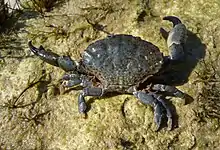 | |
| Xantho poressa (Xanthoidea: Xanthidae) | |
Scientific classification  | |
| Kingdom: | Animalia |
| Phylum: | Arthropoda |
| Subphylum: | Crustacea |
| Class: | Malacostraca |
| Order: | Decapoda |
| Infraorder: | Brachyura |
| Section: | Eubrachyura |
| Subsection: | Heterotremata Guinot, 1977 |
| Superfamilies | |
|
See text | |
Evolution
Heterotremata is the sister group to Thoracotremata within the clade Eubrachyura, having diverged during the Cretacious period. Eubrachyura itself is a subset of the larger clade Brachyura, which consists of all "true crabs". A summary of the high-level internal relationships within Brachyura can be shown in the cladogram below: [2][3]
| Brachyura |
| ||||||||||||||||||||||||
The internal relationships within Heterotremata are less certain, with many of the superfamilies found to be invalid. The proposed cladogram below is from analysis by Tsang et al, 2014:[2]
| Heterotremata |
| ||||||||||||||||||||||||||||||||||||||||||||||||||||||||||||||||||||||||||||||||||||||||||||||||||||||||||||||||||||||||||||||||||||||||||||||||||||||||||||||||||||||||||||||||||||||||||||||||||||||||||||||||||||||||||||||||||||
Superfamilies
- Aethroidea
- Bellioidea
- Bythograeoidea
- Calappoidea
- Cancroidea
- Carpilioidea
- Cheiragonoidea
- Corystoidea
- Dairoidea
- Dorippoidea
- Eriphioidea
- Gecarcinucoidea
- Goneplacoidea
- Hexapodoidea
- Leucosioidea
- Majoidea
- Orithyioidea
- Palicoidea
- Parthenopoidea
- Pilumnoidea
- Portunoidea
- Potamoidea
- Pseudothelphusoidea
- Pseudozioidea
- Retroplumoidea
- Trapezioidea
- Trichodactyloidea
- Xanthoidea
However, recent studies have found the following superfamilies and families to not be monophyletic, but rather paraphyletic or polyphyletic:[2][3]
- The superfamilies Calappoidea, Eriphioidea, and Goneplacoidea are polyphyletic
- The superfamily Potamoidea is paraphyletic with respect to Gecarcinucoidea, which is resolved by placing Gecarcinucidae within Potamoidea
- The Majoidea families Epialtidae, Mithracidae and Majidae are polyphyletic with respect to each other
- The Xanthoidea family Xanthidae is paraphyletic with respect to Panopeidae
References
- Sammy De Grave; N. Dean Pentcheff; Shane T. Ahyong; et al. (2009). "A classification of living and fossil genera of decapod crustaceans" (PDF). Raffles Bulletin of Zoology. Suppl. 21: 1–109. Archived from the original (PDF) on 2011-06-06.
- Ling Ming Tsang; Christoph D. Schubart; Shane T. Ahyong; Joelle C.Y. Lai; Eugene Y.C. Au; Tin-Yam Chan; Peter K.L. Ng; Ka Hou Chu (2014). "Evolutionary History of True Crabs (Crustacea: Decapoda: Brachyura) and the Origin of Freshwater Crabs". Molecular Biology and Evolution. Oxford University Press . 31 (5): 1173–1187. doi:10.1093/molbev/msu068.
- Wolfe, Joanna M.; Breinholt, Jesse W.; Crandall, Keith A.; Lemmon, Alan R.; Lemmon, Emily Moriarty; Timm, Laura E.; Siddall, Mark E.; Bracken-Grissom, Heather D. (24 April 2019). "A phylogenomic framework, evolutionary timeline and genomic resources for comparative studies of decapod crustaceans". Proceedings of the Royal Society B. 286 (1901). doi:10.1098/rspb.2019.0079. PMC 6501934. PMID 31014217.
External links
 Data related to Heterotremata at Wikispecies