Ginkgoidae
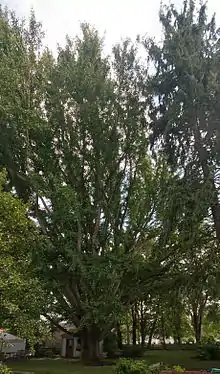
Ginkgoidae is a subclass of Equisetopsida in the sense used by Mark W. Chase and James L. Reveal in their 2009 article "A phylogenetic classification of the land plants to accompany APG III."[1] This subclass contains the single extant genus Ginkgo under order Ginkgoales, family Ginkgoaceae.[2] Its only extant species is Ginkgo biloba, the Maidenhair Tree.
| Ginkgoidae Temporal range: Jurassic to recent | |
|---|---|
 | |
| Scientific classification | |
| Kingdom: | |
| Class: | |
| Subclass: | Ginkgoidae Engl. in H.G.A.Engler & K.A.E.Prantl 1897 |
| Order: | Gorozh. 1904 |
| Family: | Engl. in H.G.A.Engler & K.A.E.Prantl 1897 |
| Genera | |
| |
Phylogeny
The following diagram shows a likely phylogenic relationship between subclass Ginkgoidae and the other Equisetopsida subclasses.[2]
|
References
- Mark W. Chase; James L. Reveal (2009). "A phylogenetic classification of the land plants to accompany APG III". Botanical Journal of the Linnean Society. 161 (2): 122–127. doi:10.1111/j.1095-8339.2009.01002.x.
- Maarten J. M. Christenhusz; James L. Reveal; Aljos Farjon; Martin F. Gardner; Robert R. Mill; Mark W. Chase (2011). "A new classification and linear sequence of extant gymnosperms" (PDF). Phytotaxa. 19: 55–70. doi:10.11646/phytotaxa.19.1.3.
This article is issued from Wikipedia. The text is licensed under Creative Commons - Attribution - Sharealike. Additional terms may apply for the media files.