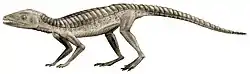
Crocodyliformes
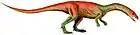
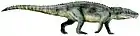
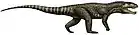
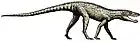
Crocodyliformes is a clade of crurotarsan archosaurs, the group often traditionally referred to as "crocodilians". They are the first members of Crocodylomorpha to possess many of the features that define later relatives. They are the only pseudosuchians to survive the K-Pg extinction event.
| Crocodyliformes Temporal range: Late Triassic–Recent, | |
|---|---|
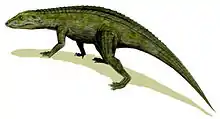 | |
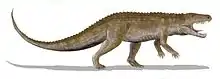
| Protosuchus, an early crocodyliform | |
Scientific classification  | |
| Kingdom: | Animalia |
| Phylum: | Chordata |
| Class: | Reptilia |
| Clade: | Pseudosuchia |
| Clade: | Loricata |
| Superorder: | Crocodylomorpha |
| Clade: | Crocodyliformes Hay, 1930 |
| Clades | |
| |
In 1988, Michael J. Benton and James M. Clark argued that all traditional names for well-known groups of animals should be restricted to their crown clades, that is, used only for natural groups comprising all living members of any given lineage. This posed a problem for the crocodilians, because the name Crocodylia, while used in various ways by various scientists, had always included not only living crocodilians but many of their extinct ancestors known only from the fossil record.[1]
Benton and Clark's solution to this issue was to restrict the name Crocodylia to the group containing modern alligators, crocodiles, and gharials, plus any extinct members of those specific families. The traditional group "Crocodylia" was replaced by the name Crocodyliformes, which included many of the extinct families that the new definition left out. Clark and Benton did not initially provide an exact definition for Crocodyliformes; but, in 2001, Paul Sereno and colleagues defined it as the clade including Protosuchus richardsoni and the Nile crocodile, plus all descendants of their common ancestor.[2]
Chris Brochu agreed with the assessment that Crocodylia as a name has never had stable contents, and that a series of clades larger than the crown group Crocodylia (including Crocodyliformes and the slightly more inclusive clade Crocodylomorpha) was a good solution.[3] However, in a 2008 paper, Jeremy Martin and Benton reversed the previous opinion (co-authored by Benton) that Crocodylia should be restricted to the crown group, suggesting that Crocodyliformes should be considered a synonym of a more inclusive Crocodylia, and thus replaced.[4] Brochu and colleagues rejected this proposal, arguing that the crown definition of Crocodylia is the standard meaning both within and beyond the crocodyliform systematics community.[5]
Ecology
While all extant crocodilians are carnivorous, the ecological roles of Mesozoic crocodyliforms were more diverse, and included omnivory and herbivory. Herbivorous forms were present from the early Jurassic to the late Cretaceous and are thought to have evolved at least three times.[6]
Fossil tracks
Tracks of a crocodyliform are known since Cretaceous, at least. Tracks representing the ichnofamily Batrachopodidae are described from the Early Cretaceous (late Aptian) Calonda Formation (Angola) by Mateus et al. (2017), who name a new ichnotaxon Angolaichnus adamanticus.[7]
Phylogeny
Below is a simplified cladogram based on Fiorelli and Calvo (2007).[8]
| Crocodylomorpha |
| ||||||||||||||||||||||||||||||||||||||||||||||||||||||
In 2012, paleontologists Mario Bronzati, Felipe Chinaglia Montefeltro, and Max C. Langer conducted a broad phylogenetic analysis to produce supertrees of Crocodyliformes, including 184 species. The most parsimonious trees were highly resolved, meaning the phylogenetic relationships found in the analysis were highly likely. Below is a consensus tree from the study:[9]
| ||||||||||||||||||||||||||||||||||||||||||||||||||||||||||||||||||||||||||||||||||||||||||||||||||||||||||||||||||||||||||||||||||||||||||||||||||||||||||||||||||||||||||||||||||||||||||||||||||||||||||||||||||||||||||||||||||||||||||||||||||||||||||||||||||||||||||||||||||||||||||||||||||||||||||||||||||||||||||||||||||||||||||||||||||||||||||
References
- Benton, M.J. and Clark, J.M. (1988). "Archosaur phylogeny and the relationships of the Crocodylia." Pp. 295–338 in Benton, M.J. (ed.), The phylogeny and classification of the Tetrapods, volume 1. Oxford: Clarendon Press.
- Sereno, P.C.; Larson, H.C.E.; Sidor, C.A.; Gado, B. (2001). "The giant crocodyliform Sarcosuchus from the Cretaceous of Africa". Science. 294 (5546): 1516–1519. Bibcode:2001Sci...294.1516S. doi:10.1126/science.1066521. PMID 11679634. S2CID 22956704.
- Brochu, C.A. (2003). "Phylogenetic approaches toward crocodylian history". Annu. Rev. Earth Planet. Sci. 31 (31): 357–397. Bibcode:2003AREPS..31..357B. doi:10.1146/annurev.earth.31.100901.141308.
- Martin, J.E.; Benton, M.J. (2008). "Crown Clades in Vertebrate Nomenclature: Correcting the Definition of Crocodylia". Systematic Biology. 57 (1): 173–181. doi:10.1080/10635150801910469. PMID 18300130.
- Brochu, A.C.; Wagner, J.R.; Jouve, S.; Sumrall, C.D.; Densmore, L.D. (2009). "A correction corrected: consensus over the meaning of Crocodylia and why it matters". Systematic Biology. 58 (5): 537–543. doi:10.1093/sysbio/syp053. PMID 20525607.
- Melstrom, K. M.; Irmis, R. B. (2019). "Repeated Evolution of Herbivorous Crocodyliforms during the Age of Dinosaurs". Current Biology. 29 (14): 2389–2395.e3. doi:10.1016/j.cub.2019.05.076. PMID 31257139.
- Octávio Mateus; Marco Marzola; Anne S. Schulp; Louis L. Jacobs; Michael J. Polcyn; Vladimir Pervov; António Olímpio Gonçalves; Maria Luisa Morais (2017). "Angolan ichnosite in a diamond mine shows the presence of a large terrestrial mammaliamorph, a crocodylomorph, and sauropod dinosaurs in the Early Cretaceous of Africa". Palaeogeography, Palaeoclimatology, Palaeoecology. 471: 220–232. Bibcode:2017PPP...471..220M. doi:10.1016/j.palaeo.2016.12.049.
- Fiorelli, LE; Calvo, JO (2007). "The first "protosuchian" (Archosauria: Crocodyliformes) from the Cretaceous (Santonian) of Gondwana". Arquivos do Museu Nacional, Rio de Janeiro. 65 (4): 417–459.
- Bronzati, M.; Montefeltro, F. C.; Langer, M. C. (2012). "A species-level supertree of Crocodyliformes". Historical Biology. 24 (6): 598–606. doi:10.1080/08912963.2012.662680. S2CID 53412111.
| |||||||||||||||||||||||||||||||||||||||||||||
| |||||||||||||||||||||||||||||||||||||||||||||
| |||||||||||||||||||||||||||||||||||||||||||||
| |||||||||||||||||||||||||||||||||||||||||||||
| |||||||||||||||||||||||||||||||||||||||||||||