Cristidiscoidea
Cristidiscoidea or Nucleariae is a proposed basal holomycota clade in which Fonticula and Nucleariida emerged, as sister of the fungi. Since it is close to the divergence between the main lineages of fungi and animals, the study of Cristidiscoidea can provide crucial information on the divergent lifestyles of these groups and the evolution of opisthokonts and slime mold multicellularity.[1] The holomycota tree is following Tedersoo et al.[2][3][4]
| Opisthokonts |
| |||||||||||||||||||||||||||||||||||||||||||||||||||||||||||||||||||||||||||||||||||||||||||||||||||

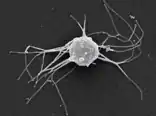
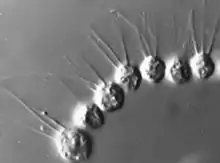

| Cristidiscoidea | |
|---|---|
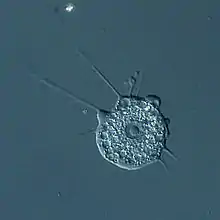 | |
| Nuclearia thermophila | |
| Scientific classification | |
| Domain: | |
| (unranked): | |
| (unranked): | |
| Class: | Cristidiscoidea |
| Orders | |
Classification
- Class Cristidiscoidea Cavalier-Smith 1998[5][6][7][8][9][10][11]
- Order Fonticulida Cavalier-Smith 1993
- Family Fonticulidae Worley, Raper & Hohl 1979
- Genus Fonticula Worley, Raper & Hohl 1979
- Genus Parvularia López-Escardó 2017[12]
- Species P. atlantis López-Escardó 2017
- Family Fonticulidae Worley, Raper & Hohl 1979
- Order Nucleariida Cavalier-Smith 1993
- Family Nucleariidae Cann & Page 1979
- Genus Nuclearia Cienkowski 1865
- Family Nucleariidae Cann & Page 1979
- Order Fonticulida Cavalier-Smith 1993
References
- Brown, Matthew W.; Spiegel, Frederick W.; Silberman, Jeffrey D. (2009-12-01). "Phylogeny of the "Forgotten" Cellular Slime Mold, Fonticula alba, Reveals a Key Evolutionary Branch within Opisthokonta". Molecular Biology and Evolution. 26 (12): 2699–2709. doi:10.1093/molbev/msp185. ISSN 0737-4038. PMID 19692665.
- Tedersoo, Leho; Sánchez-Ramírez, Santiago; Kõljalg, Urmas; Bahram, Mohammad; Döring, Markus; Schigel, Dmitry; May, Tom; Ryberg, Martin; Abarenkov, Kessy (2018). "High-level classification of the Fungi and a tool for evolutionary ecological analyses". Fungal Diversity. 90 (1): 135–159. doi:10.1007/s13225-018-0401-0. ISSN 1560-2745.
- Hibbett, David S.; Blackwell, Meredith; James, Timothy Y.; Spatafora, Joseph W.; Taylor, John W.; Vilgalys, Rytas (2018). "Phylogenetic taxon definitions for Fungi, Dikarya, Ascomycota and Basidiomycota". IMA Fungus. 9 (2): 291–298. doi:10.5598/imafungus.2018.09.02.05. ISSN 2210-6340. PMC 6317587. PMID 30622884.
- Arroyo, Alicia S.; López-Escardó, David; Kim, Eunsoo; Ruiz-Trillo, Iñaki; Najle, Sebastián R. (2018-07-12). "Novel Diversity of Deeply Branching Holomycota and Unicellular Holozoans Revealed by Metabarcoding in Middle Paraná River, Argentina". Frontiers in Ecology and Evolution. 6: 99. doi:10.3389/fevo.2018.00099. ISSN 2296-701X.
- Adl; et al. (September 2012), "The Revised Classification of Eukaryotes" (PDF), Journal of Eukaryotic Microbiology, 59 (5): 429–493, doi:10.1111/j.1550-7408.2012.00644.x, PMC 3483872, PMID 23020233
- Silar, Philippe (2016), "Protistes Eucaryotes : Origine, Evolution et Biologie des Microbes Eucaryotes", HAL Archives-ouvertes: 1–462
- Ruggiero; et al. (29 April 2015), "Higher Level Classification of All Living Organisms", PLOS ONE, 10 (4): e0119248, Bibcode:2015PLoSO..1019248R, doi:10.1371/journal.pone.0119248, PMC 4418965, PMID 25923521
- Ondřej Zicha (1999), "Nuclearia", BioLib.cz, retrieved 2016-04-21
- Kaiqin, Xu (2007), "Nuclearia", The World of Protozoa, Rotifera, Nematoda and Oligochaeta, retrieved 2016-04-21
- Kaiqin, Xu (2007), "Astrodisculus", The World of Protozoa, Rotifera, Nematoda and Oligochaeta, retrieved 2016-04-21
- "Nuclearia", Wikispecies, retrieved 2016-04-21
- López-Escardó, David; López-García, Purificación; Moreira, David; Ruiz-Trillo, Iñaki; Torruella, Guifré (2017). "Parvularia atlantis gen. et sp. nov., a Nucleariid Filose Amoeba (Holomycota, Opisthokonta)". Journal of Eukaryotic Microbiology. 65 (2): 170–179. doi:10.1111/jeu.12450. ISSN 1550-7408. PMC 5708529. PMID 28741861.
This article is issued from Wikipedia. The text is licensed under Creative Commons - Attribution - Sharealike. Additional terms may apply for the media files.