Neornithischia
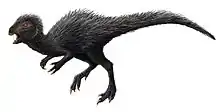
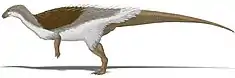
Neornithischia ("new ornithischians") is a clade of the dinosaur order Ornithischia. It is the sister group of the Thyreophora within the clade Genasauria. Neornithischians are united by having a thicker layer of asymmetrical enamel on the inside of their lower teeth. The teeth wore unevenly with chewing and developed sharp ridges that allowed neornithischians to break down tougher plant food than other dinosaurs. Neornithischians include a variety of basal forms historically known as "hypsilophodonts", including the Parksosauridae; in addition, there are derived forms classified in the groups Marginocephalia and Ornithopoda. The former includes clades Pachycephalosauria and Ceratopsia, while the latter typically includes Hypsilophodon and the more derived Iguanodontia.
| Neornithischians Temporal range: Early Jurassic–Late Cretaceous, | |
|---|---|
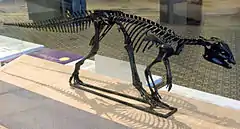 | |
| Hypsilophodon skeletal mount at the Brussels Science Institute | |
Scientific classification  | |
| Kingdom: | Animalia |
| Phylum: | Chordata |
| Clade: | Dinosauria |
| Order: | †Ornithischia |
| Clade: | †Genasauria |
| Clade: | †Neornithischia Cooper, 1985 |
| Subgroups | |
Classification
Neornithischia was first named by Cooper in 1985 and defined as "all genasaurians more closely related to Parasaurolophus walkeri Parks, 1922, than to Ankylosaurus magniventris Brown, 1908 or Stegosaurus stenops Marsh, 1877a".[1] In 2021, Neornithischia was given a formal definition under the PhyloCode: "The largest clade containing Iguanodon bernissartensis Boulenger in Beneden, 1881 and Triceratops horridus Marsh, 1889 but not Ankylosaurus magniventris Brown, 1908 and Stegosaurus stenops Marsh, 1887."[2]
A 2017 study by Matthew G. Baron, David B. Norman, and Paul M. Barrett recovered the Early Jurassic taxon Lesothosaurus diagnosticus from Southern Africa as the most basal known member of Neornithischia – a position previously held by Stormbergia dangershoeki (a taxon considered by the authors to be an adult form of Lesothosaurus and therefore a junior subjective synonym). However, Baron et al. go on to state that this result is only poorly supported and that future studies will be needed in order to better resolve the base of the ornithischian tree.[3]
The below cladogram follows an analysis by Clint A. Boyd published in 2015 on the relationships of neornithischians:[4]
| Ornithischia |
| ||||||||||||||||||||||||||||||||||||||||||||||||||||||||||||||||||||||||||||||||||||||||||||||||||||||||||||||||||||||||||||||||||||||||||||||||
The cladogram below results from analysis by Herne et al., 2019.[5] Parksosaurus and Elasmaria were recovered within Ornithopoda, among other revised relationships.
| Ornithischia |
| ||||||||||||||||||||||||||||||||||||||||||||||||||||||||||||||||||||||||||||||||||||||||||||||||||||||||||||||||||||||||||||||||||||||||||||||||||||||||||||||||||||||||
References
- Richard J. Butler; Paul Upchurch; David B. Norman (2008). "The phylogeny of the ornithischian dinosaurs". Journal of Systematic Palaeontology. 6 (1): 1–40. doi:10.1017/S1477201907002271.
- Madzia D, Arbour VM, Boyd CA, Farke AA, Cruzado-Caballero P, Evans DC. 2021. The phylogenetic nomenclature of ornithischian dinosaurs. PeerJ 9:e12362
- Matthew G. Baron; David B. Norman; Paul M. Barrett (2016). "Postcranial anatomy of Lesothosaurus diagnosticus (Dinosauria: Ornithischia) from the Lower Jurassic of southern Africa: implications for basal ornithischian taxonomy and systematics". Zoological Journal of the Linnean Society. doi:10.1111/zoj.12434.
- Clint A. Boyd (2015). "The systematic relationships and biogeographic history of ornithischian dinosaurs". PeerJ. 3 (e1523). doi:10.7717/peerj.1523. PMC 4690359. PMID 26713260.
- Herne, Matthew C.; Nair, Jay P.; Evans, Alistair R.; Tait, Alan M. (2019). "New small-bodied ornithopods (Dinosauria, Neornithischia) from the Early Cretaceous Wonthaggi Formation (Strzelecki Group) of the Australian-Antarctic rift system, with revision of Qantassaurus intrepidus Rich and Vickers-Rich, 1999". Journal of Paleontology. doi:10.1017/jpa.2018.95.
- Butler, R.J. (2005). "The 'fabrosaurid' ornithischian dinosaurs of the Upper Elliot Formation (Lower Jurassic) of South Africa and Lesotho". Zoological Journal of the Linnean Society. 145 (2): 175-18. doi:10.1111/j.1096-3642.2005.00182.x.
- Sereno, P.C. (1986). "Phylogeny of the bird-hipped dinosaurs (order Ornithischia)". National Geographic Research. 2 (2): 234–56.
External links
| ||||||||||||||||||||||||||||||||||||||||||||
| ||||||||||||||||||||||||||||||||||||||||||||