Anomocephaloidea
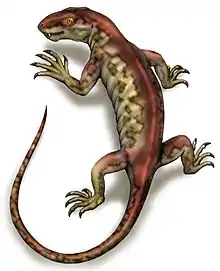
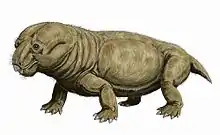
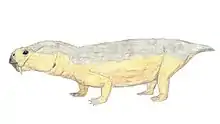
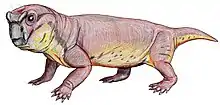
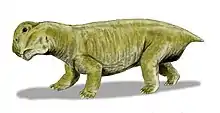
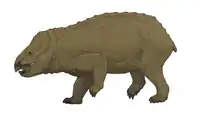
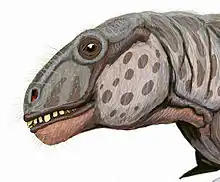
Anomocephaloidea is a clade (evolutionary grouping) of anomodont therapsids that existed in Gondwana during the Middle Permian and includes two species, Anomocephalus africanus from South Africa and Tiarajudens eccentricus from Brazil, both of which are characterized by large body size and teeth that fit tightly together or occlude.
| Anomocephaloidea Temporal range: Middle Permian | |
|---|---|
 | |
Scientific classification  | |
| Kingdom: | Animalia |
| Phylum: | Chordata |
| Clade: | Synapsida |
| Clade: | Therapsida |
| Suborder: | †Anomodontia |
| Clade: | †Anomocephaloidea Cisneros et al., 2011 |
| Genera | |
Anomocephaloidea is among the most basal groups of anomodonts, the other being Venyukovioidea, which differs in being a Laurasian clade of mostly small-bodied species.[1] Anomocephaloidea was named in 2011 with the discovery of Tiarajudens; Anomocephalus had been known since 1999,[2] but was unique among anomodonts until Tiarajudens was described. Both Anomocephalus and Tiarajudens were herbivores, although the latter possessed a pair of saber-like canine teeth that may have been used in display or combat with other individuals of the same species.[3] Although Anomocephaloidea was short-lived and had a limited geographic distribution, it was part of a larger evolutionary radiation of anomodonts in the Middle Permian characterized by the evolution of a diverse array of new morphological characteristics and ecological roles, and that would later lead to the rise of Dicynodontia, the largest clade within Anomodontia and one of the most successful groups of tetrapods in the Permian.[1][3]
Below is a cladogram from Cisneros et al. (2011) showing the phylogenetic position of Anomocephaloidea:[1]
| Therapsida |
| |||||||||||||||||||||||||||||||||||||||||||||||||||||||||||||||||||||||||||||||||||||||||||||||||||||||||||||||||||||||||||
References
- Cisneros, J. C.; Abdala, F.; Rubidge, B. S.; Dentzien-Dias, P. C.; Bueno, A. d. O. (2011). "Dental Occlusion in a 260-Million-Year-Old Therapsid with Saber Canines from the Permian of Brazil". Science. 331 (6024): 1603–5. doi:10.1126/science.1200305. PMID 21436452.
- Modesto, S.; Rubidge, B.; Welman, J. (1999). "The most basal anomodont therapsid and the primacy of Gondwana in the evolution of the anomodonts". Proceedings of the Royal Society B: Biological Sciences. 266 (1417): 331–337. doi:10.1098/rspb.1999.0642. PMC 1689688.
- Cisneros, Juan Carlos; Abdala, Fernando; Jashashvili, Tea; De Oliveira Bueno, Ana; Dentzien-Dias, Paula (2015). "Tiarajudens eccentricusand Anomocephalus africanus, two bizarre anomodonts (Synapsida, Therapsida) with dental occlusion from the Permian of Gondwana". Royal Society Open Science. 2 (7): 150090. doi:10.1098/rsos.150090. PMC 4632579. PMID 26587266.
| |||||||||||||||||||||||||||||||||||||||||
| |||||||||||||||||||||||||||||||||||||||||
| |||||||||||||||||||||||||||||||||||||||||
| |||||||||||||||||||||||||||||||||||||||||
| |||||||||||||||||||||||||||||||||||||||||