Albertaceratops
Albertaceratops (meaning "Alberta horned face") was a genus of centrosaurine horned dinosaur from the middle Campanian-age Upper Cretaceous Oldman Formation of Alberta, Canada.[1]
| Albertaceratops Temporal range: Late Cretaceous, | |
|---|---|
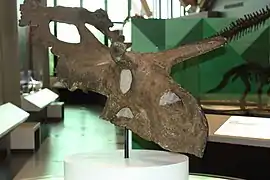 | |
| Skull in Philip J. Currie Dinosaur Museum | |
Scientific classification  | |
| Kingdom: | Animalia |
| Phylum: | Chordata |
| Clade: | Dinosauria |
| Order: | †Ornithischia |
| Suborder: | †Ceratopsia |
| Family: | †Ceratopsidae |
| Subfamily: | †Centrosaurinae |
| Genus: | †Albertaceratops Ryan, 2007 |
| Species: | †A. nesmoi |
| Binomial name | |
| †Albertaceratops nesmoi Ryan, 2007 | |
Description
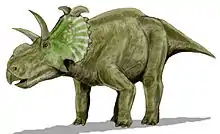
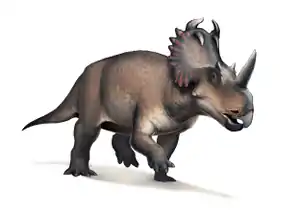
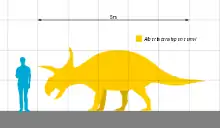
Albertaceratops is unusual in combining long brow horns with an otherwise centrosaurine skull, as centrosaurines normally possess short brow horns. Over its nose was a bony ridge, and on its frill were two large outwardly-projecting hooks.[1] Its size has been estimated at 5.8 metres (19 ft) and 3,500 kilograms (7,700 lb).[2]
Discovery and naming
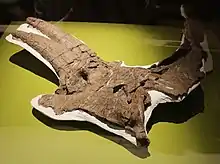
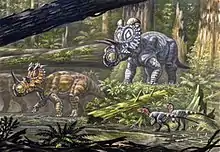
Albertaceratops is known from a single complete skull (TMP.2001.26.1) found in August 2001 and skull and postcranial fragments. A phylogenetic analysis carried out by its describer, Michael J. Ryan, found it to be the most basal centrosaurine.[1] Additional specimens were reported from a bonebed in the Judith River Formation of Montana, which is equivalent to the Oldman Formation and differentiated only by the Canada–US border. However, further study showed these remains to come from a different centrosaurine, Medusaceratops. Both ceratopsids lived during the same time period, about 77.5 million years ago.[3]
The specific name, A. nesmoi, is derived from the name of Cecil Nesmo, a rancher living in Manyberries, Alberta, a town of less than 100 people located 71 km south of Medicine Hat. The rancher was thus honored in recognition of his efforts to aid fossil hunters.[1]
Classification
The cladogram presented below follows a phylogenetic analysis by Chiba et al. (2017), which included a systematic re-evaluation of Medusaceratops lokii:[4]
| Centrosaurinae |
| |||||||||||||||||||||||||||||||||||||||||||||||||||||||||||||||||||||||||||||||||||||||||||||||||||||||||||||||
See also
References
- Ryan, Michael J. (2007). "A New Basal Centrosaurine Ceratopsid from the Oldman Formation, Southeastern Alberta". Journal of Paleontology. 81 (2): 376–396. doi:10.1666/0022-3360(2007)81[376:ANBCCF]2.0.CO;2. ISSN 0022-3360.
- Paul, G.S., 2010, The Princeton Field Guide to Dinosaurs, Princeton University Press p. 259
- Ryan, Michael J.; Russell, Anthony P., and Hartman, Scott. (2010). "A New Chasmosaurine Ceratopsid from the Judith River Formation, Montana", In: Michael J. Ryan, Brenda J. Chinnery-Allgeier, and David A. Eberth (eds), New Perspectives on Horned Dinosaurs: The Royal Tyrrell Museum Ceratopsian Symposium, Indiana University Press, 656 pp. ISBN 0-253-35358-0.
- Kentaro Chiba; Michael J. Ryan; Federico Fanti; Mark A. Loewen; David C. Evans (2018). "New material and systematic re-evaluation of Medusaceratops lokii (Dinosauria, Ceratopsidae) from the Judith River Formation (Campanian, Montana)". Journal of Paleontology. in press (2): 272–288. doi:10.1017/jpa.2017.62. S2CID 134031275.
External links
 |
Wikispecies has information related to Albertaceratops. |
- Drawing of the skull, by Julius T. Csotonyi
- An article about Cecil Nesmo from the Calgary Sun
| |||||||||||||||||||||||||||||||||||||||||||||||||
| |||||||||||||||||||||||||||||||||||||||||||||||||
| |||||||||||||||||||||||||||||||||||||||||||||||||
| |||||||||||||||||||||||||||||||||||||||||||||||||
.png.webp)