Detarioideae
The subfamily Detarioideae is one of the subdivisions of the plant family Fabaceae (legumes). This subfamily includes many tropical trees, some of which are used for timber or have ecological importance. The subfamily consists of 84 genera, most of which are native to Africa and Asia. Pride of Burma (Amherstia nobilis) and tamarind (Tamarindus indica) are two of the most notable species in Detarioideae. It has the following clade-based definition:
The most inclusive crown clade containing Goniorrhachis marginata Taub. and Aphanocalyx cynometroides Oliv., but not Cercis canadensis L., Duparquetia orchidacea Baill., or Bobgunnia fistuloides (Harms) J. H. Kirkbr. & Wiersema.[1]
| Detarioideae | |
|---|---|
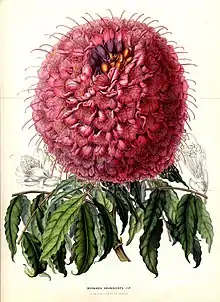 | |
| Brownea grandiceps Lemaire 1850 | |
Scientific classification  | |
| Kingdom: | Plantae |
| Clade: | Tracheophytes |
| Clade: | Angiosperms |
| Clade: | Eudicots |
| Clade: | Rosids |
| Order: | Fabales |
| Family: | Fabaceae |
| Subfamily: | Detarioideae Burmeist. 1837[1] |
| Type genus | |
| Detarium Juss. | |
| Tribes[2] | |
| |
| Synonyms | |
| |

Taxonomy
Detarioideae comprises the following tribes and genera:[1][2]
Schotieae
- Schotia Jacq.
Barnebydendreae
- Barnebydendron J.H.Kirkbr.
- Goniorrhachis Taub.
Detarieae
- Augouardia Pellegr.
- Baikiaea Benth.
- Brandzeia Baill.
- Colophospermum J. Kirk ex J. Léonard
- Copaifera L.
- Daniellia Benn.
- Detarium Juss.
- Eperua Aubl.
- Eurypetalum Harms
- Gilletiodendron Vermoesen
- Guibourtia Benn.
- Hardwickia Roxb.
- Hylodendron Taub.
- Hymenaea L.
- Neoapaloxylon Rauschert
- Peltogyne Vogel
- Prioria Griseb.
- Sindora Miq.
- Sindoropsis J. Léonard
- Stemonocoleus Harms
- Tessmannia Harms
Saraceae
- Endertia Steenis & de Wit
- Leucostegane Prain
- Lysidice Hance
- Saraca L.
Afzelieae
- Afzelia Sm.
- Brodriguesia R.S. Cowan
- Intsia Thouars
Amherstieae
- Amherstia Wall.
- Annea Mackinder & Wieringa[3]
- Anthonotha P. Beauv.
- Aphanocalyx Oliver
- Berlinia Sol. ex Hook. f.
- Bikinia Wieringa
- Brachycylix (Harms) R.S. Cowan
- Brachystegia Benth.
- Brownea Jacq.
- Browneopsis Huber
- Crudia Schreb.
- Cryptosepalum Benth.
- Cynometra L.
- Dicymbe Spruce ex Benth. & Hook. f.
- Didelotia Baill.
- Ecuadendron D.A. Neill
- Elizabetha Schomb. ex Benth.
- Englerodendron Harms
- Gabonius Wieringa & Mackinder[4]
- Gilbertiodendron J. Léonard
- Heterostemon Desf.
- Humboldtia Vahl
- Hymenostegia (Benth.) Harms
- Icuria Wieringa
- Isoberlinia Craib & Stapf ex Holland
- Isomacrolobium Aubrév. & Pellegr.
- Julbernardia Pellegr.
- Lebruniodendron J. Léonard
- Leonardoxa Aubrév.
- Librevillea Hoyle
- Loesenera Harms
- Macrolobium Schreb.
- Maniltoa Scheff.
- Michelsonia Hauman
- Micklethwaitia G.P. Lewis & Schrire
- Microberlinia A. Chev.
- Neochevalierodendron J. Léonard
- Normandiodendron J. Léonard
- Oddoniodendron De Wild.
- Paloue Aubl.
- Paloveopsis R.S. Cowan
- Paramacrolobium J.Léonard
- Plagiosiphon Harms
- Polystemonanthus Harms
- Pseudomacrolobium Hauman
- Scorodophloeus Harms
- Talbotiella Baker f.
- Tamarindus L.
- Tetraberlinia (Harms) Hauman
- Zenkerella Taub.
Phylogenetics
Detarioideae exhibits the following phylogenetic relationships:[2][5][6][7][8][9]
| Fabales |
| |||||||||||||||||||||||||||||||||||||||||||||||||||||||||||||||||||||||||||||||||||||||||||||||||||||||||||||||||||||||||||||||||||||||||||||||||||||||||||||||||||||||||||||||||||||||||||||||||||||||||||||||||||||||||||||||||||||||||||||||||||||||||||||||||||||||||||||||||||||||||||||||||||||||||||||||||||||||||||||||||||||||||||||||||||||||||||||||||||||||||||||||||||||||||||||||||||||||||||||||||||||
References
- The Legume Phylogeny Working Group (LPWG). (2017). "A new subfamily classification of the Leguminosae based on a taxonomically comprehensive phylogeny". Taxon. 66 (1): 44–77. doi:10.12705/661.3.
- de la Estrella M, Forest F, Klitgård B, Lewis GP, Mackinder BA, de Queiroz LP, Wieringa JJ, Bruneau A. (2018). "A new phylogeny-based tribal classification of subfamily Detarioideae, an early branching clade of florally diverse tropical arborescent legumes". Scientific Reports. 8 (1): 6884. Bibcode:2018NatSR...8.6884D. doi:10.1038/s41598-018-24687-3. PMC 5932001. PMID 29720687.
{{cite journal}}: CS1 maint: uses authors parameter (link) - Mackinder BA, Wieringa JJ (2013). "Annea gen. nov. (Detarieae, Caesalpinioideae, Leguminosae), a home for two species long misplaced in Hymenostegia sensu lato". Phytotaxa. 142 (1): 1–14. doi:10.11646/phytotaxa.142.1.1.
- Wieringa JJ, Mackinder BA, Van Proosdij ASJ (2013). "Gabonius gen. nov.(Leguminosae, Caesalpinioideae, Detarieae), a distant cousin of Hymenostegia endemic to Gabon". Phytotaxa. 142 (1): 15–24. doi:10.11646/phytotaxa.142.1.2.
- Bruneau A, Forest F, Herendeen PS, Klitgaard BB, Lewis GP (2001). "Phylogenetic relationships in the Caesalpinioideae (Leguminosae) as inferred from chloroplast trnL intron sequences". Syst Bot. 26 (3): 487–514. doi:10.1043/0363-6445-26.3.487 (inactive 28 February 2022).
{{cite journal}}: CS1 maint: DOI inactive as of February 2022 (link) - Bruneau A, Mercure M, Lewis GP, Herendeen PS (2008). "Phylogenetic patterns and diversification in the caesalpinioid legumes". Botany. 86 (7): 697–718. doi:10.1139/B08-058.
- Cardoso D, Pennington RT, de Queiroz LP, Boatwright JS, Van Wykd BE, Wojciechowskie MF, Lavin M (2013). "Reconstructing the deep-branching relationships of the papilionoid legumes". S. Afr. J. Bot. 89: 58–75. doi:10.1016/j.sajb.2013.05.001.
- de la Estrella M, Wieringa JJ, Mackinder B, van der Burgt X, Devesa JA, Bruneau A (2014). "Phylogenetic analysis of the African genus Gilbertiodendron J. Léonard and related genera (Leguminosae-Caesalpinioideae-Detarieae)". International Journal of Plant Sciences. 175 (9): 975–985. doi:10.1086/677648. S2CID 83648906.
- Mackinder BA, Saslis-Lagoudakis H, Wieringa JJ, Devey D, Forest F, Bruneau A (2013). "The tropical African legume Scorodophloeus clade includes two undescribed Hymenostegia segregate genera and Micklethwaitia, a rare, monospecific genus from Mozambique". S. Afr. J. Bot. 89: 156–163. doi:10.1016/j.sajb.2013.07.002.
- Redden RM, Herendeen PS (2006). "Morphology and Phylogenetic Analysis of Paloue and Related Genera in the Brownea Clade (Detarieae, Caesalpinioideae)". International Journal of Plant Sciences. 167 (6): 1229–1246. doi:10.1086/508065. S2CID 83720699.
- Redden KM, Herendeen PS, Wurdack KJ, Bruneau A (2010). "Phylogenetic Relationships of the Northeastern South American Brownea Clade of Tribe Detarieae (Leguminosae: Caesalpinioideae) Based on Morphology and Molecular Data". Syst Bot. 35 (3): 524–533. doi:10.1600/036364410792495863. S2CID 85708423.
 Media related to Detarioideae at Wikimedia Commons