Afrosoricida
The order Afrosoricida (a Latin-Greek compound name which means "looking like African shrews") contains the golden moles of Southern Africa, the otter shrews of equatorial Africa and the tenrecs of Madagascar. These three families of small mammals have traditionally been considered to be a part of the order Insectivora, and were later included in Lipotyphla after Insectivora was abandoned as a wastebasket taxon, before Lipotyphla was also found to be polyphyletic.
| Afrosoricida[1] Temporal range: | |
|---|---|
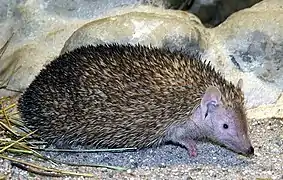 | |
| Lesser hedgehog tenrec (Echinops telfairi) | |
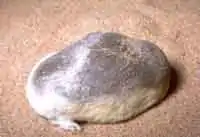 | |
| Grant's golden mole (Eremitalpa granti) | |
Scientific classification  | |
| Kingdom: | Animalia |
| Phylum: | Chordata |
| Class: | Mammalia |
| Clade: | Afroinsectivora |
| Order: | Afrosoricida Stanhope et al., 1998 |
| Suborders | |
Naming
Some biologists use Tenrecomorpha as the name for the tenrec-golden mole clade, but Gary Bronner and Paulina Jenkins argue that Afrosoricida is more appropriate, despite their misgivings about the similarity between the name "Afrosoricida" and the unrelated shrew subgenus Afrosorex.[1] However, Afrosorex Hutterer, 1986 is a synonym of Crocidura Wagler, 1832, eliminating any confusion.[2]
Biology
As a rule, tenrecs and otter shrews tend to be small animals varying from 4 cm to 39 cm in length. There is no pronounced body type since they have evolved to take over the insect-eating niche in Madagascar. However, based on the niche occupied, they look like shrews, hedgehogs or otters. Their coat can vary from smooth to spiny and the coloration of the fur is generally dirt brown. Most species are also nocturnal and have poor eyesight. However, their whiskers are rather sensitive and they can detect very minute vibrations in the ground to locate their prey.
Phylogeny
Traditionally, these two families were grouped with the hedgehogs, shrews and moles in the Lipotyphla. However, there have always been minority opinions suggesting that Tenrecomorpha, or at least the golden moles, are not true lipotyphlans. These opinions are now supported by many genetic studies indicating an association between Tenrecomorpha and various other African mammals in the superorder Afrotheria.[3][4][5] Afrosoricids are sometimes considered part of the Afroinsectiphilia, a clade within Afrotheria.
| Cladogram of living Afrosoricida[5][6] | |||||||||||||||||||||||||||||||||||||||||||||||||||||||||||||||||||||||||||||||||||||||||||||||||||||||||||||||||||||||||||||||||||||||||||||||||||||||||||||||||||||||||||||||||||||||||||||
|
- Infraclass Eutheria: placental mammals
- Superorder Afrotheria
- Clade Afroinsectiphilia
- Clade Afroinsectivora
- Order Afrosoricida
- Suborder Tenrecomorpha (otter shrews and tenrecs)
- Family Potamogalidae (otter shrews)
- Family Tenrecidae (tenrecs)
- Subfamily Geogalinae (1 species)
- Genus Geogale
- Subfamily Oryzorictinae (24 species)
- Genus Microgale
- Short-tailed shrew tenrec (Microgale brevicaudata)
- Cowan's shrew tenrec (Microgale cowani)
- Drouhard's shrew tenrec (Microgale drouhardi)
- Dryad shrew tenrec (Microgale dryas)
- Pale shrew tenrec (Microgale fotsifotsy)
- Gracile shrew tenrec (Microgale gracilis)
- Naked-nosed shrew tenrec (Microgale gymnorhyncha)
- Jenkins's shrew tenrec (Microgale jenkinsae)
- Northern shrew tenrec (Microgale jobihely)
- Lesser long-tailed shrew tenrec (Microgale longicaudata)
- Major's long-tailed tenrec (Microgale majori)
- Web-footed tenrec (Microgale mergulus)
- Montane shrew tenrec (Microgale monticola)
- Nasolo's shrew tenrec (Microgale nasoloi)
- Pygmy shrew tenrec (Microgale parvula)
- Greater long-tailed shrew tenrec (Microgale principula)
- Least shrew tenrec (Microgale pusilla)
- Shrew-toothed shrew tenrec (Microgale soricoides)
- Taiva shrew tenrec (Microgale taiva)
- Thomas's shrew tenrec (Microgale thomasi)
- Genus Nesogale
- Genus Oryzorictes
- Genus Microgale
- Subfamily Tenrecinae (5 species)
- Subfamily Geogalinae (1 species)
- Incertae familiae: Genus †Plesiorycteropus
- †Plesiorycteropus madagascariensis
- †Plesiorycteropus germainepetterae
- Suborder Chrysochloridea (golden moles)
- Family Chrysochloridae (golden moles)
- Subfamily Chrysochlorinae (11 species)
- Genus Carpitalpa
- Genus Chlorotalpa
- Genus Chrysochloris
- Subgenus Chrysochloris
- Subgenus Kilimatalpa
- Genus Chrysospalax
- Genus Cryptochloris
- Genus Eremitalpa
- Subfamily Amblysominae (10 species)
- Genus Amblysomus
- Genus Calcochloris
- Subgenus Huetia
- Subgenus Calcochloris
- Subgenus incertae sedis
- Genus Neamblysomus
- Subfamily Chrysochlorinae (11 species)
- Family Chrysochloridae (golden moles)
- Suborder Tenrecomorpha (otter shrews and tenrecs)
- Order Afrosoricida
- Clade Afroinsectivora
- Clade Afroinsectiphilia
- Superorder Afrotheria
References
- Bronner, G.N.; Jenkins, P.D. (2005). "Order Afrosoricida". In Wilson, D.E.; Reeder, D.M (eds.). Mammal Species of the World: A Taxonomic and Geographic Reference (3rd ed.). Johns Hopkins University Press. pp. 71–81. ISBN 978-0-8018-8221-0. OCLC 62265494.
- Hutterer, R. (2005). "Order Soricomorpha". In Wilson, D.E.; Reeder, D.M (eds.). Mammal Species of the World: A Taxonomic and Geographic Reference (3rd ed.). Johns Hopkins University Press. p. 224. ISBN 978-0-8018-8221-0. OCLC 62265494.
- Stanhope, M.J.; Waddell, V.G.; Madsen, O.; de Jong, W.; Hedges, S.B.; Cleven, G.C.; Kao, D.; Springer, M.S. (1998). "Molecular evidence for multiple origins of Insectivora and for a new order of endemic African insectivore mammals". Proceedings of the National Academy of Sciences. 95 (17): 9967–9972. Bibcode:1998PNAS...95.9967S. doi:10.1073/pnas.95.17.9967. PMC 21445. PMID 9707584.
- Douady, C.J.; Douzery, E.J.P. (2003). "Molecular estimation of eulipotyphlan divergence times and the evolution of "Insectivora"". Molecular Phylogenetics and Evolution. 28 (2): 285–296. doi:10.1016/S1055-7903(03)00119-2. PMID 12878465.
- Everson, K. M.; Soarimalala, V.; Goodman, S. M.; Olson, L. E. (2016). "Multiple Loci and Complete Taxonomic Sampling Resolve the Phylogeny and Biogeographic History of Tenrecs (Mammalia: Tenrecidae) and Reveal Higher Speciation Rates in Madagascar's Humid Forests". Systematic Biology. 65 (5): 890–909. doi:10.1093/sysbio/syw034. PMID 27103169.
- Upham, Nathan S.; Esselstyn, Jacob A.; Jetz, Walter (2019). "Inferring the mammal tree: Species-level sets of phylogenies for questions in ecology, evolution and conservation". PLOS Biol. 17 (12): e3000494. doi:10.1371/journal.pbio.3000494. PMC 6892540. PMID 31800571.