Osteolepiformes
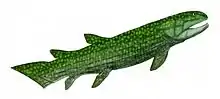
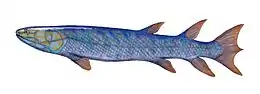
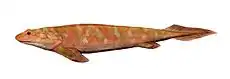
Osteolepiformes, also known as Osteolepidida, is a group of prehistoric lobe-finned fishes which first appeared during the Devonian period. The order contains five families: Canowindridae, Megalichthyidae, Osteolepidae, Thysanolepidae and Tristichopteridae. The order is generally considered to be paraphyletic because the characters that define it are mainly attributes of stem tetrapodomorphs.[1]
| Osteolepiformes Temporal range: Middle Devonian to Late Carboniferous | |
|---|---|
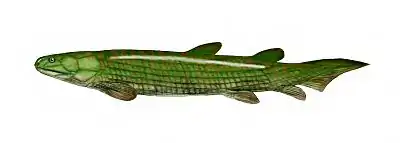 | |
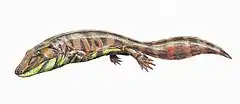
| Osteolepis | |
Scientific classification | |
| Kingdom: | Animalia |
| Phylum: | Chordata |
| Clade: | Tetrapodomorpha |
| Order: | †Osteolepiformes Berg, 1937 |
| Groups included | |
| Cladistically included but traditionally excluded taxa | |
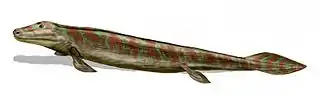
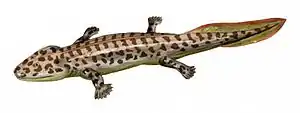
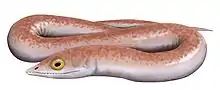
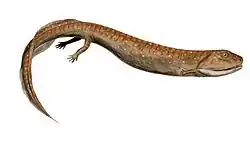
Below is a cladogram showing the paraphyly of Osteolepiformes compiled and modified from Ahlberg and Johanson (1998).[1] See also Swartz (2012).[2] Osteolepiformes is marked by the green bracket.
|
Osteolepiformes |
References
- Ahlberg, P. E.; Johanson, Z. (1998). "Osteolepiforms and the ancestry of tetrapods" (PDF). Nature. 395 (6704): 792–794. Bibcode:1998Natur.395..792A. doi:10.1038/27421. S2CID 4430783. Archived from the original (PDF) on 2014-11-24. Retrieved 2013-11-25.
- Swartz, B. (2012). "A marine stem-tetrapod from the Devonian of Western North America". PLOS ONE. 7 (3): e33683. Bibcode:2012PLoSO...733683S. doi:10.1371/journal.pone.0033683. PMC 3308997. PMID 22448265.
External links
.jpg.webp)

This article is issued from Wikipedia. The text is licensed under Creative Commons - Attribution - Sharealike. Additional terms may apply for the media files.