31 Cygni
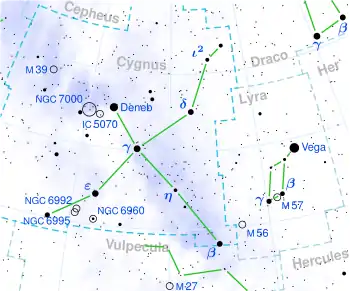
31 Cygni, also known as ο1 Cygni, Omicron1 Cygni, or V695 Cygni, is a star in the constellation Cygnus.
  | |
| Observation data Epoch J2000.0 Equinox J2000.0 | |
|---|---|
| Constellation | Cygnus |
| Right ascension | 20h 13m 37.911s[1] |
| Declination | +46° 44′ 28.739″[1] |
| Apparent magnitude (V) | 3.73 - 3.89[2] |
| Characteristics | |
| Spectral type | K4Iab + B4IV-V[2] |
| Variable type | Algol[2] |
| Astrometry | |
| Radial velocity (Rv) | –7.41 ± 0.08[3] km/s |
| Proper motion (μ) | RA: 0.133 ± 0.672[1] mas/yr Dec.: 4.834 ± 0.633[1] mas/yr |
| Parallax (π) | 4.3432 ± 0.3464 mas[1] |
| Distance | 750 ± 60 ly (230 ± 20 pc) |
| Orbit[4] | |
| Period (P) | 3,784.3 d |
| Eccentricity (e) | 0.2084 ± 0.0031 |
| Periastron epoch (T) | 2,452,345 ± 9 |
| Argument of periastron (ω) (secondary) | 204.5 ± 1.0° |
| Semi-amplitude (K1) (primary) | 13.94 ± 0.04 km/s |
| Semi-amplitude (K2) (secondary) | 18.0[5] km/s |
| Details | |
| K supergiant | |
| Mass | 6.73[5] M☉ |
| Radius | 127[6] R☉ |
| Luminosity | 2,512 - 2,559[6] L☉ |
| Temperature | 4,043±170[6] K |
| B dwarf | |
| Mass | 5.22[5] M☉ |
| Radius | 5.2 ± 0.5[7] R☉ |
| Temperature | 16,500+1,000 −2,000[8] K |
| Age | 39.8[9] Myr |
| Other designations | |
| Database references | |
| SIMBAD | data |
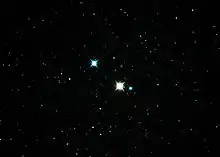
The Bayer designation ο (omicron) has been variously applied to two or three of the stars 30, 31, and 32 Cygni. 31 Cygni has been designated, variously, as ο1 or ο2 Cygni — therefore for clarity, it is preferred to use the Flamsteed designation 31 Cygni.[10]
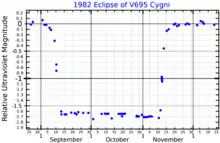
It is an Algol-type eclipsing binary and ranges between magnitudes 3.73 and 3.89 over a period of ten years. The component stars are an orange supergiant of spectral type K4Iab and a blue-white star likely to be evolving off the main sequence with a spectral type of B4IV-V. The eclipsing system has been studied in attempts to determine an accurate direct mass for a red supergiant. The value 6.73 M☉ is believed to be accurate to about 2%, but there are some discrepancies in the orbital fit.[5]
30 Cygni is another naked eye star a tenth of a degree away, forming a bright triple.
32 Cygni is about a degree away to the north, also a detached eclipsing binary system. It comprises a large cool evolved star and a small hot main sequence or subgiant companion.
References
- Brown, A. G. A.; et al. (Gaia collaboration) (August 2018). "Gaia Data Release 2: Summary of the contents and survey properties". Astronomy & Astrophysics. 616. A1. arXiv:1804.09365. Bibcode:2018A&A...616A...1G. doi:10.1051/0004-6361/201833051. Gaia DR2 record for this source at VizieR.
- Samus, N. N.; Durlevich, O. V.; et al. (2009). "VizieR Online Data Catalog: General Catalogue of Variable Stars (Samus+ 2007-2013)". VizieR On-line Data Catalog: B/GCVS. Originally Published in: 2009yCat....102025S. 1. Bibcode:2009yCat....102025S.
- Eaton, Joel A.; et al. (2008). "Orbits and Pulsations of the Classical ζ Aurigae Binaries". The Astrophysical Journal. 679 (2): 1490–1498. arXiv:0802.2238. Bibcode:2008ApJ...679.1490E. doi:10.1086/587452. S2CID 2079219.
- Griffin, R. F. (2008). "Spectroscopic binary orbits from photoelectric radial velocities - Paper 202: 31 and 32 Cygni". The Observatory. 128: 362. Bibcode:2008Obs...128..362G.
- Bennett, Philip; Brown, Alexander; Ayres, Thomas R. (2018). "An Accurate Mass of the 31 Cygni Red Supergiant". Cambridge Workshop on Cool Stars: 46. Bibcode:2018csss.confE..46B. doi:10.5281/zenodo.1467958.
- Messineo, M.; Brown, A. G. A. (2019). "A Catalog of Known Galactic K-M Stars of Class I Candidate Red Supergiants in Gaia DR2". The Astronomical Journal. 158 (1): 20. arXiv:1905.03744. Bibcode:2019AJ....158...20M. doi:10.3847/1538-3881/ab1cbd. S2CID 148571616.
- Eaton, Joel A. (1993). "31 Cygni: The B star and the wind". Astronomical Journal. 106: 2081. Bibcode:1993AJ....106.2081E. doi:10.1086/116787.
- Di Benedetto, G. P.; Ferluga, S. (1990). "Angular diameters of Zeta Aurigae-type supergiants by Michelson interferometry". Astronomy and Astrophysics. 236: 449. Bibcode:1990A&A...236..449D.
- Tetzlaff, N.; et al. (January 2011). "A catalogue of young runaway Hipparcos stars within 3 kpc from the Sun". Monthly Notices of the Royal Astronomical Society. 410 (1): 190–200. arXiv:1007.4883. Bibcode:2011MNRAS.410..190T. doi:10.1111/j.1365-2966.2010.17434.x. S2CID 118629873.
- Kostjuk, N. D. (2004). "VizieR Online Data Catalog: HD-DM-GC-HR-HIP-Bayer-Flamsteed Cross Index (Kostjuk, 2002)". VizieR On-line Data Catalog: IV/27A. Originally Published in: Institute of Astronomy of Russian Academy of Sciences (2002). 4027. Bibcode:2004yCat.4027....0K.
- Stencel, Robert E.; Hopkins, Jeffrey L.; Hagen, Wendy; Fried, Robert; Schmidtke, Paul C.; Kondo, Yoji; Chapman, Robert D. (June 1984). "The 1982 eclipse of 31 Cygni". The Astrophysical Journal. 281: 751–759. Bibcode:1984ApJ...281..751S. doi:10.1086/162153. Retrieved 21 December 2021.