Okinawan scripts
Okinawan, spoken in Okinawa Island, was once the official language of the Ryukyu Kingdom. At the time, documents were written in kanji and hiragana, derived from Japan.
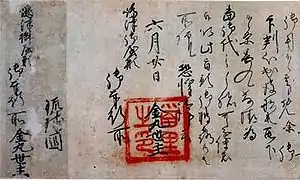
Although generally agreed among linguists to be a distinct language, most Japanese, as well as most Okinawans, tend to think of Okinawan as merely a regional dialect of Japanese, even though it is not intelligible to monolingual Japanese speakers.[1] Modern Okinawan is not written frequently. When it is, the Japanese writing system is generally used in an ad hoc manner. There is no standard orthography for the modern language. Nonetheless, there are a few systems used by scholars and laypeople alike. None of them are widely used by native speakers, but represent the language with less ambiguity than the ad hoc conventions. The Roman alphabet in some form or another is used in some publications, especially those of an academic nature.
Systems
Conventional usages
The modern conventional ad hoc spellings found in Okinawa.
Council system
The system devised by the Council for the Dissemination of Okinawan Dialect (沖縄方言普及協議会).
University of the Ryukyus system
This system was devised by Okinawa Center of Language Study, a section of University of the Ryukyus. Unlike others, this method is intended purely as a phonetic guidance, and basically only uses katakana. For the sake of an easier comparison, corresponding hiragana are used in this article.
New Okinawan letters
新沖縄文字 (Shin Okinawa-moji), devised by Yoshiaki Funazu (船津好明, Funazu Yoshiaki), in his textbook Utsukushii Okinawa no Hōgen (美しい沖縄の方言; "The beautiful Okinawan Dialect"; ISBN 4-905784-19-0). The rule applies to hiragana only. Katakana is used as in Japanese; just like in the conventional usage of Okinawan.
Basic syllables and kai-yōon (palatalized syllables)
| i | u | e | o | ya | yu | yo | ||
|---|---|---|---|---|---|---|---|---|
| (Initial) 1 | [i] [ji] | [u] [wu] | [e] [je] | [o] [wo] | [ja] | [ju] | [jo] | |
| (Elsewhere) | (Not used) 2 | |||||||
| Conventional | い | う をぅ | え いぇ | お を うぉ | や | ゆ | よ | |
| Council | ゆぃ | をぅ | ゆぇ | を | ||||
| Ryukyu Univ. | ゐ | え | ||||||
| New Okinawan | い゙ |  | え゙ | |||||
| ' | 'a a | 'i i | 'u u | 'e e | 'o o | 'ya | 'yu | 'yo |
| (Initial) 1 | [ʔa] | [ʔi] | [ʔu] | [ʔe] | [ʔo] | [ʔja] | [ʔju] | [ʔjo] |
| (Elsewhere) | [a] | [i] [ji] | [u] [wu] | [e] [je] | [o] [wo] | |||
| Conventional | あ | い | う | え いぇ | お うぉ | や | ゆ | よ |
| Council | え | お | っや | っゆ | っよ | |||
| Ryukyu Univ. | いぇ | いゃ | いゅ | いょ | ||||
| New Okinawan | え |  |  |  | ||||
| k | ka | ki | ku | ke | ko | kya | ||
| [ka] | [ki] | [ku] | [ke] | [ko] | [kja] | |||
| か | き | く | け | こ | きゃ | |||
| g | ga | gi | gu | ge | go | gya | ||
| [ɡa] | [ɡi] | [ɡu] | [ɡe] | [ɡo] | [ɡja] | |||
| が | ぎ | ぐ | げ | ご | ぎゃ | |||
| s | sa | shi si | su | she se | so | sha sya | shu syu | |
| [sa] | [ʃi] | [su] | [ʃe] | [so] | [ʃa] | [ʃu] | ||
| Others | さ | し | す | しぇ | そ | しゃ | しゅ | |
| Ryukyu Univ. | し すぃ | しぇ せ | ||||||
| z | za | zi | zu | ze | zo | |||
| [dza] | [dzi] [dʐi] | [dzu] | [dze] | [dzo] | ||||
| Others | ざ | じ | ず | ぜ | ぞ | |||
| Ryukyu Univ. | づぃ | ず づ | ||||||
| j | ja | ji | ju | je | jo | |||
| [dʒa] | [dʒi] | [dʒu] | [dʒe] | [dʒo] | ||||
| Others | じゃ | じ | じゅ | じぇ | じょ | |||
| Ryukyu Univ. | じゃ ぢゃ | じ ぢ | じゅ ぢゅ | じぇ ぢぇ | じょ ぢょ | |||
| t | ta | ti | tu | te | to | |||
| [ta] | [ti] | [tu] | [te] | [to] | ||||
| Others | た | てぃ | とぅ | て | と | |||
| New Okinawan |  |  | ||||||
| d | da | di | du | de | do | |||
| [da] | [di] | [du] | [de] | [do] | ||||
| Others | だ | でぃ | どぅ | で | ど | |||
| New Okinawan |  |  | ||||||
| ch c | cha ca | chi ci | chu cu | che ce | cho co | |||
| [tʃa] | [tʃi] | [tʃu] | [tʃe] | [tʃo] | ||||
| ちゃ | ち | ちゅ | ちぇ | ちょ | ||||
| ts | tsi | tsu | ||||||
| [tsi] [tʂi] | [tsu] | |||||||
| Ryukyu Univ. | つぃ | つ | ||||||
| n | na | ni | nu | ne | no | nya | nyu | |
| [na] | [ɲi] | [nu] | [ne] | [no] | [ɲa] | [ɲu] | ||
| な | に | ぬ | ね | の | にゃ | にゅ | ||
| h | ha | hi | fu hu | he | ho | hya | hyu | hyo |
| [ha] | [çi] | [ɸu] | [çe] | [ho] | [ça] | [çu] | [ço] | |
| は | ひ | ふ | へ | ほ | ひゃ | ひゅ | ひょ | |
| b | ba | bi | bu | be | bo | bya | byu | byo |
| [ba] | [bi] | [bu] | [be] | [bo] | [bja] | [bju] | [bjo] | |
| ば | び | ぶ | べ | ぼ | びゃ | びゅ | びょ | |
| p | pa | pi | pu | pe | po | pya | pyu | |
| [pa] | [pi] | [pu] | [pe] | [po] | [pja] | [pju] | ||
| ぱ | ぴ | ぷ | ぺ | ぽ | ぴゃ | ぴゅ | ||
| m | ma | mi | mu | me | mo | mya | myu | myo |
| [ma] | [mi] | [mu] | [me] | [mo] | [mja] | [mju] | [mjo] | |
| ま | み | む | め | も | みゃ | みゅ | みょ | |
| r | ra | ri | ru | re | ro | |||
| [ɾa] | [ɾi] | [ɾu] | [ɾe] | [ɾo] | ||||
| ら | り | る | れ | ろ | ||||
- 1: At the beginning of a word.
- 2: University of the Ryukyus system is an exception, always using ゐ, をぅ, え, を (ヰ, ヲゥ, エ, ヲ) for [i], [u], [e], [o], and い, う, いぇ, お (イ, ウ, イェ, オ) for [ʔi], [ʔu], [ʔe], [ʔo], respectively.
Gō-yōon (labialised syllables)
| wa | wi | we | |
|---|---|---|---|
| [ɰa] | [ɰi] | [ɰe] | |
| Conventional | わ | うぃ | うぇ |
| Council | |||
| Ryukyu Univ. | ゑぃ | ゑ | |
| New Okinawan | ゐ | ||
| ' | 'wa | 'wi | 'we |
| [ʔɰa] | [ʔɰi] | [ʔɰe] | |
| Conventional | わ | うぃ | うぇ |
| Council | っわ | っうぃ | っうぇ |
| Ryukyu Univ. | うゎ | うゐ | うぇ |
| New Okinawan |  |  |  |
| k | kwa qua | kwi qui | kwe que |
| [kʷa] | [kʷi] | [kʷe] | |
| Conventional | くぁ くゎ | くぃ | くぇ |
| Council | くゎ | ||
| Ryukyu Univ. | くゐ | ||
| New Okinawan |  |  |  |
| g | gwa | gwi | gwe |
| [ɡʷa] | [ɡʷi] | [ɡʷe] | |
| Conventional | ぐぁ ぐゎ | ぐぃ | ぐぇ |
| Council | ぐゎ | ||
| Ryukyu Univ. | ぐゐ | ||
| New Okinawan |  |  |  |
| h | fa hwa | fi hwi | fe hwe |
| [ɸa] | [ɸi] | [ɸe] | |
| Conventional | ふぁ | ふぃ | ふぇ |
| Council | |||
| Ryukyu Univ. | ふゎ | ||
| New Okinawan |  |  |  |
Others
| n 3 | 4 | 5 | |
|---|---|---|---|
| ん | っ | ー | |
| ' | 'n | ||
| Conventional | ん | ||
| Council | っん | ||
| Ryukyu Univ. | |||
| New Okinawan |  | ||
- 3: Hatsuon (moraic n)
- 4: Sokuon (geminated consonants)
- 5: Chōon (longer vowels): In conventional usages, longer vowels are sometimes spelled like in mainland Japanese as well; "ou" (おう) for ō, doubled kana for others. (e.g. うう for ū.)
References
- "Okinawan, Central". Ethnologue. Retrieved 2022-02-24.