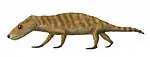
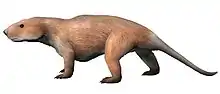
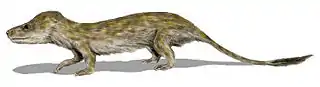
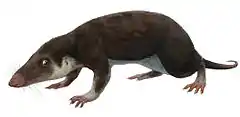
Hadrocodium
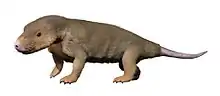
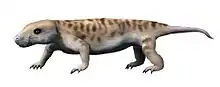
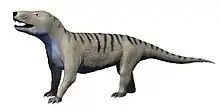
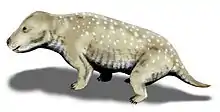
Hadrocodium wui is an extinct mammaliaform that lived during the Sinemurian stage of the Early Jurassic approximately 195 million years ago[1] in the Lufeng Formation of the Lufeng Basin in what is now the Yunnan province in south-western China[2] (25.2°N 102.1°E, paleocoordinates 34.3°N 104.9°E).[3] It is considered as the closest relative of the class Mammalia.
| Hadrocodium Temporal range: Sinemurian ~ | |
|---|---|
 | |
Scientific classification  | |
| Kingdom: | Animalia |
| Phylum: | Chordata |
| Clade: | Synapsida |
| Clade: | Therapsida |
| Clade: | Cynodontia |
| Clade: | Mammaliaformes |
| Genus: | †Hadrocodium Luo, Crompton, & Sun, 2001 |
| Species | |
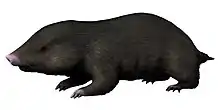
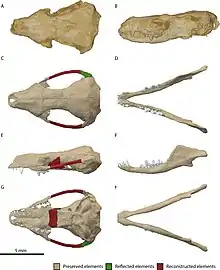
The fossil of this mouse-like, paper-clip sized animal was discovered in 1985 but was then interpreted as a juvenile morganucodontid.[4] Hadrocodium remained undescribed until 2001; since then its large brain and advanced ear structure[5] have greatly influenced the interpretation of the earliest stages of mammalian evolution, as these mammalian characters could previously be traced only to some 150 million years ago.[6] Hadrocodium is known only from a skull, but the body is estimated to have been a mere 3.2 cm (1.3 in) in length and about 2 g (0.071 oz) in mass, making it one of the smallest mammaliaform ever (in contrast, the related ancestral mammal would have been bigger, about 10 cm or 4 inches).
The name Hadrocodium alludes to its large cranial cavity,[7] deriving from the Greek word hadrós (ἁδρός 'large, heavy, fullness')[4] and the Latin word codium, from Greek kṓdeia (κώδεια 'head [of a plant]').[8] The species name, wui, is the Latinized version of discoverer Xiao-Chun Wu's name.[2]
Features
Hadrocodium might have been the first animal to have a nearly fully mammalian middle ear. It is the earliest known example of several features possessed only by mammals,[9] including the middle-ear structure characteristic of modern mammals and a relatively large brain cavity.[5] These features had been considered limited to the crown group mammals, which emerged in the Middle Jurassic; the discovery of Hadrocodium suggests that these attributes appeared 45 million years earlier than previously thought.
Whether Hadrocodium was warm-blooded or cold-blooded has not been settled, although its apparent nocturnal features would seem to place it in the former group.
Hadrocodium are capable of laying eggs like today's platypus and echidna.
Family Tree
| Cynodontia |
| ||||||||||||||||||||||||||||||||||||||||||||||||||||||||||||||||||||||||||||||
- Phylogeny [10]
| Mammaliaformes |
| ||||||||||||||||||||||||||||||||||||||||||||||||
References
- Luo, Crompton & Sun 2001, Abstract
- Parsell 2001
- Hei Koa Peng, Lufeng (CUP, IVPP) (Jurassic of China) in the Paleobiology Database. Retrieved April 2013.
- Luo, Crompton & Sun 2001, Note 1
- CNN 2001
- CMNH 2001
- Luo, Z.-X. (2001). "A New Mammaliaform from the Early Jurassic and Evolution of Mammalian Characteristics". Science. 292 (5521): 1535–40. Bibcode:2001Sci...292.1535L. doi:10.1126/science.1058476. PMID 11375489. S2CID 8738213.
- Liddell & Scott 1940
- Symmetrodonta - Palaeos
- Close, Roger A.; Friedman, Matt; Lloyd, Graeme T.; Benson, Roger B.J. (2015). "Evidence for a mid-Jurassic adaptive radiation in mammals". Current Biology. 25 (16): 2137–2142. doi:10.1016/j.cub.2015.06.047. PMID 26190074.
Bibliography
- "Hadrocodium wui". Carnegie Museum of Natural History. 2001. Archived from the original on 2012-06-17. Retrieved 1 April 2013.
- "Tiny creature may be ancestor of all mammals". CNN. May 24, 2001. Retrieved 1 April 2013.
- Liddell, Henry George; Scott, Robert (1940). "A Greek–English Lexicon: κώδεια". Perseus Digital Library. Retrieved 1 April 2013.
- Luo, Zhe-Xi; Crompton, Alfred W.; Sun, Ai-Lin (2001). "A New Mammaliaform from the Early Jurassic and Evolution of Mammalian Characteristics" (PDF). Science. 292 (5521): 1535–1540. Bibcode:2001Sci...292.1535L. doi:10.1126/science.1058476. PMID 11375489. S2CID 8738213. Archived from the original (PDF) on 2013-08-20.
- Parsell, D.L. (May 24, 2001). "Tiny Fossil From Early Jurassic Fills New Niche in Mammal Evolution". National Geographic News. Retrieved 1 April 2013.
- Rowe, Timothy; Macrini, Thomas E; Luo, Zhe-Xi (May 2011). "Fossil Evidence on Origin of the Mammalian Brain". Science. 332 (955): 955–7. Bibcode:2011Sci...332..955R. doi:10.1126/science.1203117. PMID 21596988. S2CID 940501. (Supporting online material)
External links
 |
Wikispecies has information related to Hadrocodium. |
- Rowe, Timothy; Macrini, Thomas E; Luo, Zhe-Xi (2006). "Hadrocodium wui (On-line)". Digital Morphology at the University of Texas. Retrieved 1 April 2013. — 3D models from CT scans of the original fossil
- Palaeocritti - a guide to prehistoric animals