Bunting (bird)
The buntings are a group of Old World passerine birds forming the genus Emberiza, the only genus in the family Emberizidae. They are seed-eating birds with stubby, conical bills.
| Bunting | |
|---|---|
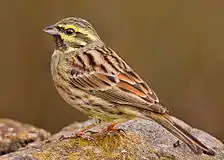 | |
| Cirl bunting (Emberiza cirlus) | |
Scientific classification  | |
| Kingdom: | Animalia |
| Phylum: | Chordata |
| Class: | Aves |
| Order: | Passeriformes |
| Superfamily: | Emberizoidea |
| Family: | Emberizidae Vigors, 1831 |
| Genus: | Emberiza Linnaeus, 1758 |
| Species | |
|
45, see text | |
| Synonyms | |
| |
Taxonomy
The family Emberizidae was formerly much larger and included the species now placed in the Passerellidae (New World sparrows) and Calcariidae (longspurs and snow buntings). Molecular phylogenetic studies found that the large family consisted of distinct clades that were better treated as separate families.[1][2]
The genus Emberiza is now the only genus placed in the family Emberizidae.[3] The genus was introduced by the Swedish naturalist Carl Linnaeus in 1758 in the tenth edition of his Systema Naturae.[4] The type species was subsequently designated as the yellowhammer (Emberiza citrinella).[5] The genus name Emberiza is from Old German Embritz, a bunting.[6] The origin of the English "bunting" is unknown.[7]
A 2008 genetic study found that three emberizid species that were placed in their own monotypic genera clustered within the Emberiza. These were the crested bunting (Melophus lathami), the slaty bunting (Latouchiornis siemsseni), and the corn bunting (Miliaria calandra).[8] All three species are now included in the genus Emberiza.[3]
A large DNA-based study of the passerines published in 2019 found that the buntings are most closely related to the longspurs and snow buntings in the family Calcariidae.[9]
Ornithologists Edward Dickinson and Leslie Christidis in the fourth edition of the Howard and Moore Complete Checklist of the Birds of the World chose to split up Emberiza and recognise the genera Fringillaria, Melophus, Granativora, Emberiza, and Schoeniclus.[10] Their example has not been followed by the online version of the Handbook of the Birds of the World[11] nor by Frank Gill and David Donsker in the list of world birds that they maintain on behalf of the International Ornithologists' Union.[3] The British Ornithologists' Union has argued that splitting the genus provides little benefit and destabilizes the nomenclature.[12]
Species in the New World genus Passerina include the word "bunting" in their common names, but are now classed in the family Cardinalidae.[13]
The family is divided into four major clades. The species in Clade I are mainly African while those in Clades II to IV are Palearctic:[14]
| Emberizidae |
| ||||||||||||||||||||||||||||||||||||||||||||||||||||||||||||||||||||||||||||||||||||||||||||||||||||||||||||||||||||||||||||||||||||||||||||||||||||||||||||||||||||||||||||||||||||||||||||||||||||||||||||||||||||||||||||||||||||||||||||||||||||||
The above cladogram is based on a study published in 2021. The phylogenetic relationships of two African species, the brown-rumped bunting (Emberiza affinis) and Vincent's bunting (Emberiza vincenti), were not determined in the study.[14]
List of species
The genus contains 45 species.[3]
- Crested bunting (Emberiza lathami)
- Slaty bunting (Emberiza siemsseni)
- Corn bunting (Emberiza calandra)
- Yellowhammer (Emberiza citrinella)
- Pine bunting (Emberiza leucocephalos)
- Rock bunting (Emberiza cia)
- Godlewski's bunting (Emberiza godlewskii)
- Meadow bunting (Emberiza cioides)
- White-capped bunting (Emberiza stewarti)
- Jankowski's bunting (Emberiza jankowskii)
- Grey-necked bunting (Emberiza buchanani)
- Cinereous bunting (Emberiza cineracea)
- Ortolan bunting (Emberiza hortulana)
- Cretzschmar's bunting (Emberiza caesia)
- Cirl bunting (Emberiza cirlus)
- Striolated bunting (Emberiza striolata)
- House bunting (Emberiza sahari)
- Lark-like bunting (Emberiza impetuani)
- Cinnamon-breasted bunting (Emberiza tahapisi)
- Gosling's bunting (Emberiza goslingi)
- Socotra bunting (Emberiza socotrana)
- Cape bunting (Emberiza capensis)
- Vincent's bunting (Emberiza vincenti)
- Tristram's bunting (Emberiza tristrami)
- Chestnut-eared bunting (Emberiza fucata)
- Little bunting (Emberiza pusilla)
- Yellow-browed bunting (Emberiza chrysophrys)
- Rustic bunting (Emberiza rustica)
- Yellow-throated bunting (Emberiza elegans)
- Yellow-breasted bunting (Emberiza aureola)
- Somali bunting (Emberiza poliopleura)
- Golden-breasted bunting (Emberiza flaviventris)
- Brown-rumped bunting (Emberiza affinis)
- Cabanis's bunting (Emberiza cabanisi)
- Chestnut bunting (Emberiza rutila)
- Tibetan bunting (Emberiza koslowi)
- Black-headed bunting (Emberiza melanocephala)
- Red-headed bunting (Emberiza bruniceps)
- Yellow bunting (Emberiza sulphurata)
- Black-faced bunting (Emberiza spodocephala)
- Masked bunting (Emberiza personata)
- Grey bunting (Emberiza variabilis)
- Pallas's reed bunting (Emberiza pallasi)
- Japanese reed bunting (Emberiza yessoensis)
- Common reed bunting (Emberiza schoeniclus)
Extinct species have been described:[15]
- † Long-legged bunting (Emberiza alcoveri) (prehistoric)
- † Emberiza shaamarica (Late Pliocene of Central Asia)[16]
- † Emberiza polgardiensis (Upper Miocene of Hungary)
- † Emberiza media (Pliocene of Hungary)
- † Emberiza parva (Pliocene of Hungary)
- †Emberiza gaspariskii (Pliocene of Hungary)
- †Emberiza bartoki (Middle Miocene of Hungary) (Nomen dubium) [16]
Emberiza pannonica from the upper Miocene of Hungary is also referred to this genus, but was later found to be a member of Muscicapidae.[16]
References
- Barker, F.K.; Burns, K.J.; Klicka, J.; Lanyon, S.M.; Lovette, I.J. (2013). "Going to extremes: contrasting rates of diversification in a recent radiation of New World passerine birds". Systematic Biology. 62 (2): 298–320. doi:10.1093/sysbio/sys094. PMID 23229025.
- Barker, F.K.; Burns, K.J.; Klicka, J.; Lanyon, S.M.; Lovette, I.J. (2015). "New insights into New World biogeography: An integrated view from the phylogeny of blackbirds, cardinals, sparrows, tanagers, warblers, and allies". Auk. 132 (2): 333–346. doi:10.1642/AUK-14-110.1.
- Gill, Frank; Donsker, David, eds. (2018). "Buntings". World Bird List Version 8.1. International Ornithologists' Union. Retrieved 2 May 2018.
- Linnaeus, Carl (1758). Systema Naturae per regna tria naturae, secundum classes, ordines, genera, species, cum characteribus, differentiis, synonymis, locis (in Latin). Vol. 1 (10th ed.). Holmiae:Laurentii Salvii. p. 176.
- Paynter, Raymond A. Jr, ed. (1970). Check-list of Birds of the World. Vol. 13. Cambridge, Massachusetts: Museum of Comparative Zoology. p. 5.
- Jobling, James A. (2010). The Helm Dictionary of Scientific Bird Names. London, United Kingdom: Christopher Helm. p. 145. ISBN 978-1-4081-2501-4.
- "Bunting". Oxford English Dictionary (Online ed.). Oxford University Press. (Subscription or participating institution membership required.)
- Alström, P.; Olsson, U.; Lei, F.; Wang, H.; Gao, W.; Sundberg, P. (2008). "Phylogeny and classification of the Old World Emberizini (Aves, Passeriformes)". Molecular Phylogenetics and Evolution. 47 (3): 960–973. doi:10.1016/j.ympev.2007.12.007. PMID 18411062.
- Oliveros, C.H.; et al. (2019). "Earth history and the passerine superradiation". Proceedings of the National Academy of Sciences of the United States of America. 116 (16): 7916–7925. doi:10.1073/pnas.1813206116. PMC 6475423. PMID 30936315.
- Dickinson, E.C.; Christidis, L., eds. (2014). The Howard & Moore Complete Checklist of the Birds of the World. Vol. 2: Passerines (4th ed.). Eastbourne, UK: Aves Press. pp. 353–357. ISBN 978-0-9568611-2-2.
- del Hoyo, Joseph (ed.). "Taxonomic structure and notes: Emberizidae". Handbook of the Birds of the World Alive. Lynx Edicions. Retrieved 25 June 2019.
- Sangster, G.; et al. (2016). "Taxonomic recommendations for Western Palearctic birds: 11th report". Ibis. 158 (1): 206–212. doi:10.1111/ibi.12322.
- Gill, Frank; Donsker, David, eds. (2019). "Cardinals, grosbeaks and (tanager) allies". World Bird List Version 9.2. International Ornithologists' Union. Retrieved 24 June 2019.
- Cai, T.; Wu, G.; Sun, L.; Zhang, Y.; Peng, Z.; Guo, Y.; Liu, X.; Pan, T.; Chang, J.; Sun, Z.; Zhang, B. (2021). "Biogeography and diversification of Old World buntings (Aves: Emberizidae): radiation in open habitats". Journal of Avian Biology. 52 (6). doi:10.1111/jav.02672. S2CID 236608560.
- Rando, J. C.; Lopez, M.; Segui, B. (1999). "A new species of extinct flightless passerine" (PDF). The Condor. 101 (1): 1–13. doi:10.2307/1370440. JSTOR 1370440.
- Palastrova, E.S; Zelenkov, N. (2020). "A Fossil Bunting Emberiza shaamarica (Aves, Emberizidae) from the Upper Pliocene of Central Asia". Paleontological Journal. 54 (6): 96–104. doi:10.1134/S0031030120060076.
Further reading
Buntings and Sparrows - A Guide to the Buntings and North American Sparrows by Urban Olsson and Jon Curson, illustrated by Clive Byers (1995) ISBN 1-873403-19-4
External links
 |
Wikisource has the text of the 1911 Encyclopædia Britannica article "Bunting (bird)". |
- Bunting videos, photos and sounds on the Internet Bird Collection
- . The American Cyclopædia. 1879.