Edaphosauridae
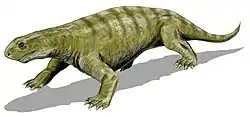
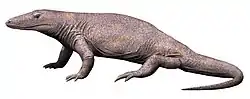
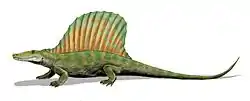
Edaphosauridae is a family of mostly large (up to 3 meters or more) Late Carboniferous to Early Permian synapsids. Edaphosaur fossils are so far known only from North America and Europe.
| Edaphosauridae Temporal range: Late Carboniferous to Early Permian | |
|---|---|
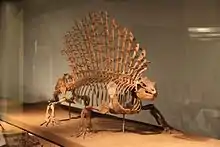 | |
| Mounted skeleton of Edaphosaurus pogonias in the Field Museum of Natural History | |
Scientific classification  | |
| Kingdom: | Animalia |
| Phylum: | Chordata |
| Clade: | Synapsida |
| Clade: | Sphenacomorpha |
| Family: | †Edaphosauridae Cope, 1882 |
| Type species | |
| †Edaphosaurus pogonias Cope, 1882 | |
| Genera | |
| |
Characteristics
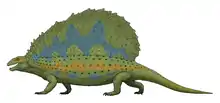
They were the earliest known herbivorous amniotes and, along with the Diadectidae, the earliest known herbivorous tetrapods. The head is small in relation to the bulky body, and there is a tall sail along the back, which may have functioned as a thermoregulatory device.
Classification
The interrelationships of Edaphosauridae was investigated in details by David M. Mazierski and Robert R. Reisz (2010). The cladogram below is modified after their phylogenetic analysis.[2]
| Edaphosauridae |
| |||||||||||||||||||||||||||||||||||||||
Below is a cladogram modified from the analysis of Benson (in press):[3]
| |||||||||||||||||||||||||||||||||||||||||||||||||||||||||||||||||||||||||||||||||||||||||||
References
- Frederik Spindler, Sebastian Voigt & Jan Fischer (2019) Edaphosauridae (Synapsida, Eupelycosauria) from Europe and their relationship to North American representatives. PalZ (advance online publication) DOI: https://doi.org/10.1007/s12542-019-00453-2 https://link.springer.com/article/10.1007/s12542-019-00453-2
- David M. Mazierski and Robert R. Reisz (2010). "Description of a new specimen of Ianthasaurus hardestiorum (Eupelycosauria: Edaphosauridae) and a re-evaluation of edaphosaurid phylogeny". Journal of Vertebrate Paleontology. 47 (6): 901–912. Bibcode:2010CaJES..47..901M. doi:10.1139/E10-017.
- Benson, R.J. (2012). "Interrelationships of basal synapsids: cranial and postcranial morphological partitions suggest different topologies". Journal of Systematic Palaeontology. 10 (4): 601–624. doi:10.1080/14772019.2011.631042. S2CID 84706899.
- Carroll, R. L. (1988), Vertebrate Paleontology and Evolution, WH Freeman & Co.
- Reisz, R. R., 1986, Handbuch der Paläoherpetologie – Encyclopedia of Paleoherpetology, Part 17A Pelycosauria Verlag Dr. Friedrich Pfeil, ISBN 3-89937-032-5
External links
| |||||||||||||||||||||||||||||||||||||||
| |||||||||||||||||||||||||||||||||||||||
| |||||||||||||||||||||||||||||||||||||||
| |||||||||||||||||||||||||||||||||||||||
.jpg.webp)
