Haemantheae
Haemantheae are a tribe of subfamily Amaryllidoideae (family Amaryllidaceae). They are herbaceous monocot perennial flowering plants with a predominantly African distribution. Three subtribes are proposed and six genera including the type genus, Haemanthus, are included. They are characterised by the presence of baccate (berry) fruit.[2]
| Haemantheae | |
|---|---|
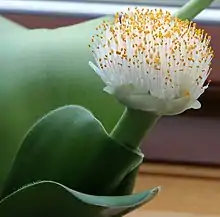 | |
| Haemanthus albiflos | |
Scientific classification  | |
| Kingdom: | Plantae |
| Clade: | Tracheophytes |
| Clade: | Angiosperms |
| Clade: | Monocots |
| Order: | Asparagales |
| Family: | Amaryllidaceae |
| Subfamily: | Amaryllidoideae |
| Tribe: | Haemantheae Hutch.[1] |
| Type genus | |
| Haemanthus | |
| Subtribes | |
Taxonomy
Phylogeny
The placement of Haemantheae within subfamily Amaryllidoideae is shown in the following cladogram:
| Cladogram: Tribes of subfamily Amaryllidoideae | |||||||||||||||||||||||||||||||||||||||||||||||||||||||||||||||||||||||||||||||||||||||
|
Subdivision
There are three subtribes, with six genera
- Cliviinae D.Müll.-Doblies & U.Müll.-Doblies
- Haemanthinae Pax
- Gethyllidinae Meerow
The subtribes are related as follows:
| Tribe Haemantheae |
| ||||||||||||
Cliviinae: Two genera - Clivia, Cryptostephanus
Haemanthinae: Type - two genera, Haemanthus, Scadoxus
Gethyllidinae: Two genera - Apodolirion, Gethyllis
References
- Fam. Fl. Pl. 2: 130. 20 Jul 1934.
- Meerow & Clayton 2004.
Bibliography
- Meerow, Alan W.; Clayton, Jason R. (1 February 2004). "Generic relationships among the baccate-fruited Amaryllidaceae (tribe Haemantheae) inferred from plastid and nuclear non-coding DNA sequences". Plant Systematics and Evolution. 244 (3–4): 141–155. doi:10.1007/s00606-003-0085-z. S2CID 10245220.
- Meerow, Alan W.; Snijman, Deirdre A. (2006). "The never-ending story: multigene approaches to the phylogeny of Amaryllidaceae". Aliso. 22: 355–366. doi:10.5642/aliso.20062201.29. Retrieved 25 January 2015.
- Vigneron, Pascal. "Amaryllidaceae". Amaryllidaceae.org (in French). Archived from the original on 4 January 2015. Retrieved 23 October 2014.
- "Amaryllidaceae: A taxonomic tool for the Amaryllidaceae of the world". eMonocot. Archived from the original on 2016-03-04. Retrieved 2016-02-25.
- Spies, P.; Grobler, J.P.; Spies, J.J. (2011). "A review of phylogenetic relationships in the genus Clivia". Philos. Trans. Genet. 1: 168–207.
- Conrad, Ferozah (February 2008). Molecular Systematics, Biogeography and Dating of the tribe Haemantheae (Amaryllidaceae) and the Phylogeography of Clivia (PhD Thesis). Department of Botany, University of Cape Town.
External links
 Media related to Haemantheae at Wikimedia Commons
 Data related to Haemantheae at Wikispecies