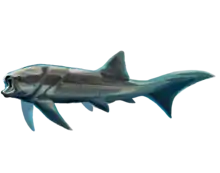
Arthrodira
Arthrodira (Greek for "jointed neck") is an order of extinct armoured, jawed fishes of the class Placodermi that flourished in the Devonian period before their sudden extinction, surviving for about 50 million years and penetrating most marine ecological niches.
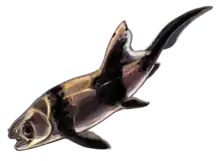
| Arthrodira Temporal range: Devonian | |
|---|---|
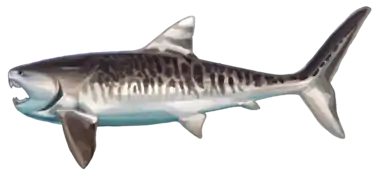 | |
| Artist's reconstruction of the arthrodire placoderm Dunkleosteus terrelli | |
Scientific classification  | |
| Kingdom: | Animalia |
| Phylum: | Chordata |
| Class: | †Placodermi |
| Order: | †Arthrodira Woodward, 1891 |
| Suborders and infraorders | |
and see text | |
Description
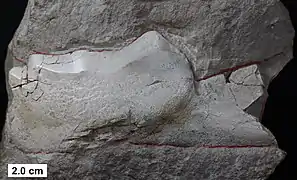
Arthrodire placoderms are notable for the movable joint between armor surrounding their heads and bodies. Like all placoderms, they lacked distinct teeth; instead, they used the sharpened edges of a bony plate on their jawbone as a biting surface. The eye sockets are protected by a bony ring, a feature shared by birds and some ichthyosaurs. Early arthrodires, such as the genus Arctolepis, were well-armoured fishes with flattened bodies. The largest member of this group, Dunkleosteus, was a true superpredator of the latest Devonian period, reaching as much as 6 m in length. In contrast, the long-nosed Rolfosteus measured just 15 cm.[1]
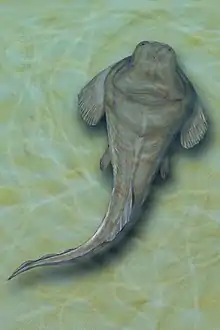
A common misconception is the arthrodires (along with all other placoderms) were sluggish bottom-dwellers that were outcompeted by more advanced fish. Leading to this misconception is that the arthrodire body plan remained relatively conserved (that is, the majority of arthrodires were bullet- or torpedo-shaped) during the Devonian period, save for increasing in size. However, during their reign, the arthrodires were one of the most diverse and numerically successful, if not the most successful, vertebrate orders of the Devonian, occupying a vast spectrum of roles from apex predator to detritus-nibbling bottom dweller. Despite their success, the arthrodires were one of many groups eliminated by the environmental catastrophes of the Late Devonian extinction, allowing other fish such as sharks to diversify into the vacated ecological niches during the Carboniferous period.
Systematics
Below is a cladogram from Dupret et al. (2009).[3]
|
Actinolepidoidei
Phlyctaeniina |
ORDER ARTHRODIRA
- Clade Aspinothoracidi
- Superfamily Dinichthyloidea
- Family Dinichthyidae
- Family Trematosteidae
- Family Rhachiosteidae
- Family Hadrosteidae
- Family Titanichthyidae
- Family Bungartiidae
- Family Selenosteidae
- Family Mylostomatidae
- Superfamily Dinichthyloidea
- Basal infraorder Actinolepina
- Family Actinolepidae
- Suborder Phlyctaenioidei
- Basal family Holonematidae
- Infraorder Phlyctaeniina
- Family Groenlandaspididae
- Family Phlyctaeniidae
- Suborder Brachythoraci
- Infraorder Coccosteina
- Superfamily Buchanosteoidea
- Family Buchanosteidae
- Superfamily Gemuendenaspoidea
- Family Gemuendenaspidae
- Superfamily Homostioidea
- Family Homostiidae
- Superfamily Brachydeiroidea
- Family Brachydeiridae
- Family Leptosteidae
- Superfamily Coccosteoidea
- Family Pholidosteidae
- Family Coccosteidae
- Family Incisoscutidae
- Family Camuropiscidae
- Superfamily Dunkleosteoidea
- (basal genus) Westralichthys
- Family Panxiosteidae
- Family Dunkleosteidae
- Superfamily Buchanosteoidea
- Infraorder Coccosteina
Genera incertae sedis
Arthrodira of unresolved relationships
- Antarctolepis
- Aspidichthys - including Anomalichthys, Aspidophorus
- Callognathus
- Copanognathus
- Carolowilhelmina
- Diplognathus
- Glyptaspis
- Grazosteus
- Hollardosteus
- Laurentaspis
- Machaerognathus
- Maideria
- Murmur - including Euptychaspis, Ptychaspis
- Overtonaspis
- Phylactaenium
- Pinguosteus
- Prescottaspis
- Qataraspis
- Taunaspis
- Timanosteus
- Trachosteus
- Wheathillaspis
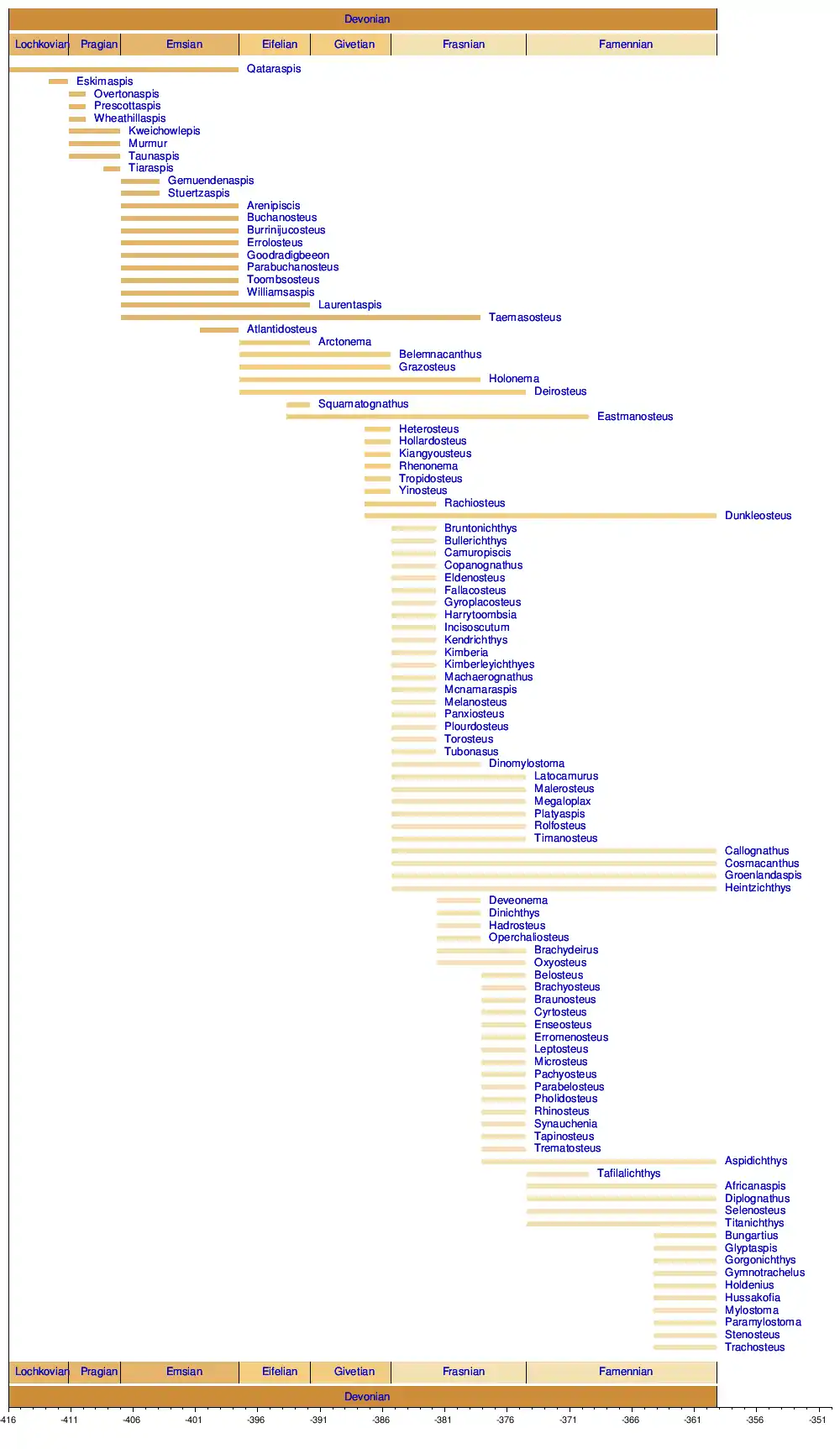
Timeline of genera
See also
Footnotes
- DENNIS, KIM, and R. S. Miles. "Eubrachythoracid arthrodires with tubular rostral plates from Gogo, Western Australia." Zoological Journal of the Linnean Society 67.4 (1979): 297-328.
- For sources, see Haaramo (2005)
- Dupret, V.; Zhu, M. I. N.; Wang, J. N. Q. (2009). "The morphology of Yujiangolepis liujingensis (Placodermi, Arthrodira) from the Pragian of Guangxi (south China) and its phylogenetic significance". Zoological Journal of the Linnean Society. 157: 70. doi:10.1111/j.1096-3642.2009.00519.x.
References
- Long, John A. (1996): The Rise of Fishes: 500 Million Years of Evolution. Johns Hopkins University Press, Baltimore. ISBN 0-8018-5438-5
- Sepkoski, Jack (2002). "A compendium of fossil marine animal genera (Placodermi entry)". Bulletins of American Paleontology. 364: 560. Archived from the original on 2004-10-14. Retrieved 2011-05-20.
External links
 |
Wikimedia Commons has media related to Arthrodira. |
| |||||||||||||||||||||||||||||||||||||||||
| |||||||||||||||||||||||||||||||||||||||||
| |||||||||||||||||||||||||||||||||||||||||
| |||||||||||||||||||||||||||||||||||||||||