Apocrita
Apocrita is a suborder of insects in the order Hymenoptera. It includes wasps, bees, and ants, and consists of many families. It contains the most advanced hymenopterans and is distinguished from Symphyta by the narrow "waist" (petiole) formed between the first two segments of the actual abdomen; the first abdominal segment is fused to the thorax, and is called the propodeum. Therefore, it is general practice, when discussing the body of an apocritan in a technical sense, to refer to the mesosoma and metasoma (or "gaster") rather than the "thorax" and "abdomen", respectively. The evolution of a constricted waist was an important adaption for the parasitoid lifestyle of the ancestral apocritan, allowing more maneuverability of the female's ovipositor.[1] The ovipositor either extends freely or is retracted, and may be developed into a stinger for both defense and paralyzing prey. Larvae are legless and blind, and either feed inside a host (plant or animal) or in a nest cell provisioned by their mothers.
| Apocrita Temporal range: | |
|---|---|
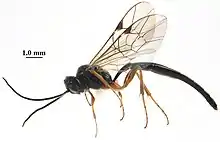 | |
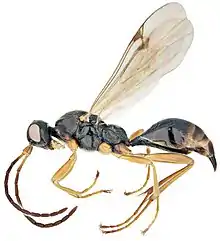
| Seleucus cuneiformis (Ichneumonidae) | |
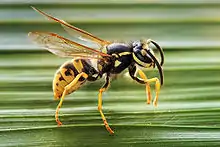 | |
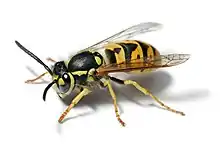
| Vespula germanica (Vespidae) | |
Scientific classification  | |
| Kingdom: | Animalia |
| Phylum: | Arthropoda |
| Class: | Insecta |
| Order: | Hymenoptera |
| (unranked): | Unicalcarida |
| Suborder: | Apocrita Gerstaecker, 1867 |
| Subgroups | |
Apocrita has historically been split into two groups, Parasitica and Aculeata. Aculeata is a clade and its name is in standard use. "Parasitica" is not a clade, as it is paraphyletic: the clade would contain the Aculeata. "Parasitica" is therefore a rankless grouping in present classifications, if it appears at all.
Parasitica comprises the majority of hymenopteran insects, its members living as parasitoids.[2][3] Most species are small, with the ovipositor adapted for piercing. In some hosts, the parasitoids induce metamorphosis prematurely, and in others it is prolonged. There are even species that are hyperparasites, or parasitoids on other parasitoids.[4] The Parasitica lay their eggs inside or on another insect (egg, larva or pupa) and their larvae grow and develop within or on that host. The host is nearly always killed. Many parasitic hymenopterans are used as biological control agents to control pests, such as caterpillars, true bugs and hoppers, flies, and weevils.[5]
Aculeata is a monophyletic group that includes those species in which the female's ovipositor is modified into a stinger to inject venom. Groups within Aculeata include the familiar ants, bees, and various types of parasitic and predatory wasps; it also includes all of the social hymenopterans.[6] Among the nonparasitic and nonsocial Aculeata, larvae are fed with captured prey (typically alive and paralyzed) or may be fed pollen and nectar. The social Aculeata feed their young prey (paper wasps and hornets), or pollen and nectar (bees), or perhaps seeds, fungi, or nonviable eggs (ants).
Extant families and superfamilies
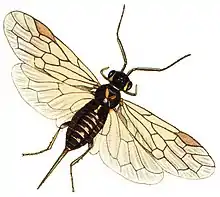
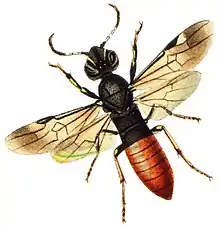
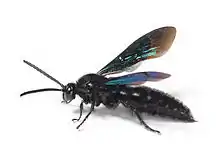
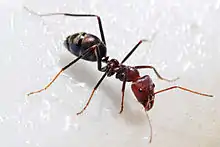
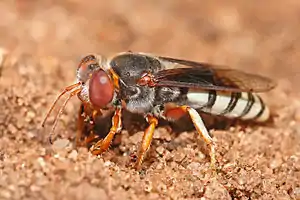
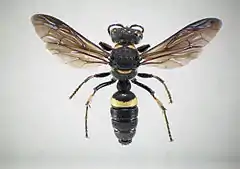
The Apocrita contains a large number of families. Some traditional taxa such as the Parasitica (containing many families of parasitoid wasps) have been found on molecular analysis to be paraphyletic. Parasitoidism evolved once, and it is found today across most Apocritan families, though it has been secondarily lost several times. The phylogenetic tree gives a condensed overview of the phylogeny, illustrated with major groups. The sawflies are paraphyletic as the Apocrita evolved inside that group. The tree is not fully resolved.[6][7][8][2]
| Hymenoptera |
| |||||||||||||||||||||||||||||||||||||||||||||||||||||||||||||||||||||||||||||||||||||||||||||||||||||||||||||||||||||
_rotated_(cropped).JPG.webp)
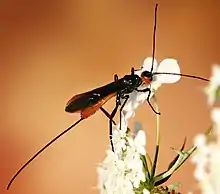
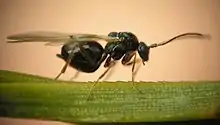
_(9687661511).jpg.webp)
.jpg.webp)

_(25808496580)_(cropped).jpg.webp)
.JPG.webp)
.jpg.webp)
.jpg.webp)
_(cropped).jpg.webp)
- Suborder Apocrita
- (unranked) Aculeata
- Superfamily Apoidea (bees and sphecoid wasps)
- Family Ampulicidae (cockroach wasps)
- Family Andrenidae (mining bees)
- Family Apidae (carpenter bees, digger bees, cuckoo bees, bumble bees, orchid bees, stingless bees, and honeybees)
- Family Colletidae (yellow-faced bees and plasterer bees)
- Family Crabronidae (sand wasps, bee wolves, etc.)
- Family Halictidae ("sweat bees")
- Family Heterogynaidae
- Family Megachilidae (leaf-cutting bees)
- Family Melittidae
- Family Stenotritidae
- Family Sphecidae (digger wasps)
- Superfamily Chrysidoidea
- Family Bethylidae
- Family Chrysididae (cuckoo wasps)
- Family Dryinidae
- Family Embolemidae
- Family Plumariidae
- Family Sclerogibbidae
- Family Scolebythidae
- Superfamily Vespoidea
- Family Bradynobaenidae
- Family Mutillidae (velvet ants)
- Family Pompilidae (spider wasps)
- Family Rhopalosomatidae
- Family Sapygidae
- Family Scoliidae
- Family Sierolomorphidae
- Family Tiphiidae
- Family Vespidae (paper wasps, potter wasps, hornets, pollen wasps, yellowjackets)
- Superfamily Formicoidea
- Family Formicidae (ants)
- Superfamily Apoidea (bees and sphecoid wasps)
- (unranked) Parasitica
- Superfamily Ceraphronoidea
- Family Ceraphronidae
- Family Megaspilidae
- Superfamily Chalcidoidea
- Family Agaonidae (fig wasps)
- Family Aphelinidae
- Family Chalcididae (chalcid wasps)
- Family Encyrtidae
- Family Eucharitidae
- Family Eulophidae
- Family Eupelmidae
- Family Eurytomidae (seed chalcids)
- Family Leucospidae
- Family Mymaridae (fairyflies) – the smallest of all insects
- Family Ormyridae
- Family Perilampidae
- Family Pteromalidae
- Family Rotoitidae
- Family Signiphoridae
- Family Tanaostigmatidae
- Family Tetracampidae
- Family Torymidae
- Family Trichogrammatidae
- Superfamily Cynipoidea
- Family Austrocynipidae
- Family Cynipidae (gall wasps)
- Family Figitidae
- Family Ibaliidae
- Family Liopteridae
- Superfamily Diaprioidea
- Family Austroniidae
- Family Diapriidae
- Family Maamingidae
- Family Monomachidae
- Superfamily Evanioidea
- Family Aulacidae
- Family Evaniidae (ensign wasps)
- Family Gasteruptiidae
- Superfamily Ichneumonoidea
- Family Braconidae
- Family Ichneumonidae (ichneumon wasps)
- Superfamily Megalyroidea
- Family Megalyridae
- Superfamily Mymarommatoidea – sometimes called Serphitoidea
- Family Mymarommatidae
- Superfamily Platygastroidea
- Family Platygastridae
- Family Scelionidae
- Superfamily Proctotrupoidea
- Family Heloridae
- Family Pelecinidae
- Family Peradeniidae
- Family Proctorenyxidae
- Family Proctotrupidae
- Family Roproniidae
- Family Vanhorniidae
- Superfamily Stephanoidea
- Family Stephanidae
- Superfamily Trigonaloidea
- Family †Maimetshidae
- Family Trigonalidae
- Superfamily Ceraphronoidea
- (unranked) Aculeata
References
- Grimaldi, David; Engel, Michael S. (2005). Evolution of the Insects. Cambridge University Press. p. 414. ISBN 978-0-521-82149-0.
- Peters, Ralph S.; Krogmann, Lars; Mayer, Christoph; Donath, Alexander; Gunkel, Simon; Meusemann, Karen; Kozlov, Alexey; Podsiadlowski, Lars; Petersen, Malte (2017). "Evolutionary History of the Hymenoptera". Current Biology. 27 (7): 1013–1018. doi:10.1016/j.cub.2017.01.027. PMID 28343967.
- Heraty, John; Ronquist, Fredrik; Carpenter, James M.; Hawks, David; Schulmeister, Susanne; Dowling, Ashley P.; Murray, Debra; Munro, James; Wheeler, Ward C. (2011). "Evolution of the hymenopteran megaradiation". Molecular Phylogenetics and Evolution. 60 (1): 73–88. doi:10.1016/j.ympev.2011.04.003. PMID 21540117.
- Sullivan, Daniel J. (2009). "Hyperparasitism". Encyclopedia of Insects. Elsevier. pp. 486–488. doi:10.1016/b978-0-12-374144-8.00138-7. ISBN 978-0-12-374144-8.
- "Parasitoid Wasps (Hymenoptera)". University of Maryland. Retrieved 6 June 2016.
- Branstetter, Michael G.; Danforth, Bryan N.; Pitts, James P.; Faircloth, Brant C.; Ward, Philip S.; Buffington, Matthew L.; Gates, Michael W.; Kula, Robert R.; Brady, Seán G. (2017). "Phylogenomic Insights into the Evolution of Stinging Wasps and the Origins of Ants and Bees". Current Biology. 27 (7): 1019–1025. doi:10.1016/j.cub.2017.03.027. PMID 28376325.
- Schulmeister, S. (2003). "Simultaneous analysis of basal Hymenoptera (Insecta), introducing robust-choice sensitivity analysis". Biological Journal of the Linnean Society. 79 (2): 245–275. doi:10.1046/j.1095-8312.2003.00233.x.
- Schulmeister, S. "Symphyta". Retrieved 28 November 2016.
- Grimaldi, D. & Engel, M.S. (2005). Evolution of the Insects. Cambridge University Press. ISBN 978-0-521-82149-0.
External links
 |
Look up apocrita in Wiktionary, the free dictionary. |
 |
Wikimedia Commons has media related to Apocrita. |
 |
Wikispecies has information related to Apocrita. |
- Suborder Apocrita – Ants, Bees and Wasps – BugGuide.Net — images and other information
- Tree of Life
- Balades Entomologiques — "entomological walks" with images (in French)