Radical 51
Radical 51 or radical dry (干部) meaning "oppose" or "dried" is one of 31 out of the total 214 Kangxi radicals written with three strokes.
| 干 | ||
|---|---|---|
| ||
| 干 (U+5E72) "oppose, dried" | ||
| Pronunciations | ||
| Pinyin: | gān | |
| Bopomofo: | ㄍㄢ | |
| Gwoyeu Romatzyh: | gan | |
| Wade–Giles: | kan1 | |
| Cantonese Yale: | gōn | |
| Jyutping: | gon1 | |
| Pe̍h-ōe-jī: | kan | |
| Japanese Kana: | カン kan (on'yomi) ほす hosu (kun'yomi) | |
| Sino-Korean: | 간 gan | |
| Names | ||
| Japanese name(s): | 干/ほす hosu 干/かん kan 一十/いちじゅう ichijū (chiefly primary education) | |
| Hangul: | 방패 banpae | |
| Stroke order animation | ||
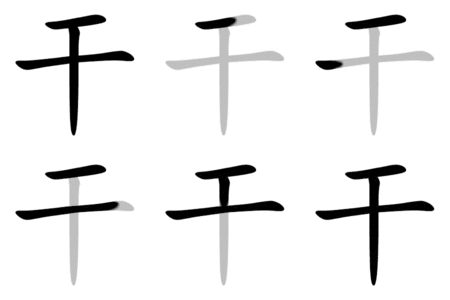 | ||
There are only nine characters derived from this radical, and some modern dictionaries have discontinued its use as a section header. In such characters that comprise 干 as a component, it mostly takes a purely phonetic role, as in 肝 "liver" (which falls under radical 130 肉 "meat").
干 is also the 27st indexing component in the Table of Indexing Chinese Character Components predominantly adopted by Simplified Chinese dictionaries published in mainland China.
Evolution
 Oracle bone script character
 Bronze script character
 Large Seal Script character
 Small Seal Script character
In origin, the character depicts a kind of fork used as a weapon used in hunting or in warfare, or alternatively either a pestle or a shield. It can be traced to the seal script.
Derived characters
| Strokes | Characters |
|---|---|
| + 0 | 干 |
| + 2 | 平SC/TC/JP/平KO |
| + 3 | 年 幵 并 (also SC form of 並 -> 一 / 併 -> 人) |
| + 5 | 幷/幷Kangxi (=并) 幸 |
| +10 | 幹 |
In simplified Chinese
As a character (not a radical), 干 has risen to new importance, and even notoriety due to the 20th-century Chinese writing reform. In simplified Chinese, 干 takes the place of a number of other characters with the phonetic value gān or gàn, e.g. of 乾 "dry" or 幹 "trunk, body", so that 干 may today take a wide variety of meanings.
The high frequency and polysemy of the character poses a serious problem for Chinese translation software. The word 幹 gàn "tree trunk; to do" (rarely also "human body"), rendered as 干 in simplified Chinese, acquired the meaning of "to fuck" in Chinese slang. Notoriously, the 2002 edition of the widespread Jinshan Ciba Chinese-to-English dictionary for the Jinshan Kuaiyi translation software rendered every occurrence of 干 as "fuck", resulting in a large number of signs with irritating English translations throughout China, often mistranslating 乾 gān "dried" as in 干果 "dried fruit" in supermarkets as "fuck the fruits" or similar.[1]
Literature
- Fazzioli, Edoardo (1987). Chinese calligraphy : from pictograph to ideogram : the history of 214 essential Chinese/Japanese characters. calligraphy by Rebecca Hon Ko. New York: Abbeville Press. ISBN 0-89659-774-1.
- Leyi Li: “Tracing the Roots of Chinese Characters: 500 Cases”. Beijing 1993, ISBN 978-7-5619-0204-2
- Rick Harbaugh, Chinese Characters: A Genealogy and Dictionary, Yale University Press (1998), ISBN 978-0-9660750-0-7.
See also
References
- Victor Mair, The Etiology and Elaboration of a Flagrant Mistranslation, Language Log, December 2007.
