Radical 4
Radical 4 or radical slash (丿部) meaning "slash" or "bend" is one of 6 of the 214 Kangxi radicals that are composed of only one stroke.
| 丿 | ||
|---|---|---|
| ||
| 丿 (U+4E3F) "slash" | ||
| Pronunciations | ||
| Pinyin: | piě | |
| Bopomofo: | ㄆ一ㄝˇ | |
| Wade–Giles: | p'ieh3 | |
| Cantonese Yale: | pit3 | |
| Jyutping: | pit3 | |
| Pe̍h-ōe-jī: | phia̍t | |
| Japanese Kana: | ヘツ hetsu (on'yomi) | |
| Sino-Korean: | 별 byeol | |
| Names | ||
| Chinese name(s): | 撇 piě | |
| Japanese name(s): | ノ no はらいぼう haraibō | |
| Hangul: | 삐침 ppichim | |
| Stroke order animation | ||
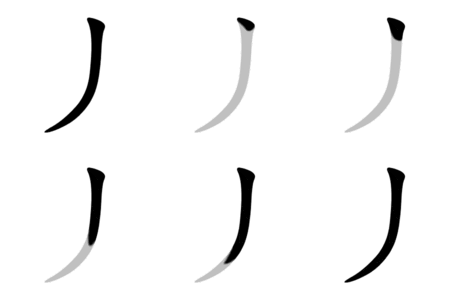 | ||
In the Kangxi Dictionary, there are 33 characters (out of 49,030) to be found under this radical.
It is highly similar to the Japanese katakana, no (ノ), thus colloquially referred to as "no" in Japanese.
丿 is also the 4th indexing component in the Table of Indexing Chinese Character Components predominantly adopted by Simplified Chinese dictionaries published in mainland China.
Evolution
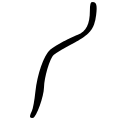 Large seal script character
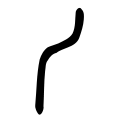 Small seal script character
Derived characters
| Strokes | Characters |
|---|---|
| +0 | 丿 乀 乁 |
| +1 | 乂 乃 乄JP |
| +2 | 久 乆 (=久) 乇 么 (also SC form of 麼 -> 广) 义SC (=義 -> 羊) 乊 之 乡SC (=鄉 -> 邑) |
| +3 | 乌SC (=烏 -> 火) 乏 |
| +4 | 乍 乎 乐SC (=樂 -> 木) |
| +5 | 丢 眾 乒 乓 乔SC (=喬 -> 口) |
| +6 | 乕 (=虎 -> 虍) |
| +7 | 乖 |
| +8 | 乗JP (=乘) |
| +9 | 乘 |
In calligraphy
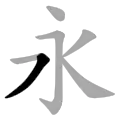 The 6th principle stroke 掠 lüè as in 永
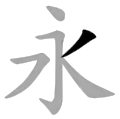 The 7th principle stroke 啄 zhuó as in 永
The only left-falling stroke in Radical 4, known as 撇 piě, is basic to Chinese calligraphy. It has two different forms, 掠 lüè and zhuó, in the eight principles of 永 (永字八法 Yǒngzì Bāfǎ).
Literature
- Fazzioli, Edoardo (1987). Chinese calligraphy : from pictograph to ideogram : the history of 214 essential Chinese/Japanese characters. calligraphy by Rebecca Hon Ko. New York: Abbeville Press. ISBN 0-89659-774-1.
- Leyi, Li (1993). Tracing the Roots of Chinese Characters: 500 Cases. Beijing. ISBN 978-7-5619-0204-2.

This article is issued from Wikipedia. The text is licensed under Creative Commons - Attribution - Sharealike. Additional terms may apply for the media files.